
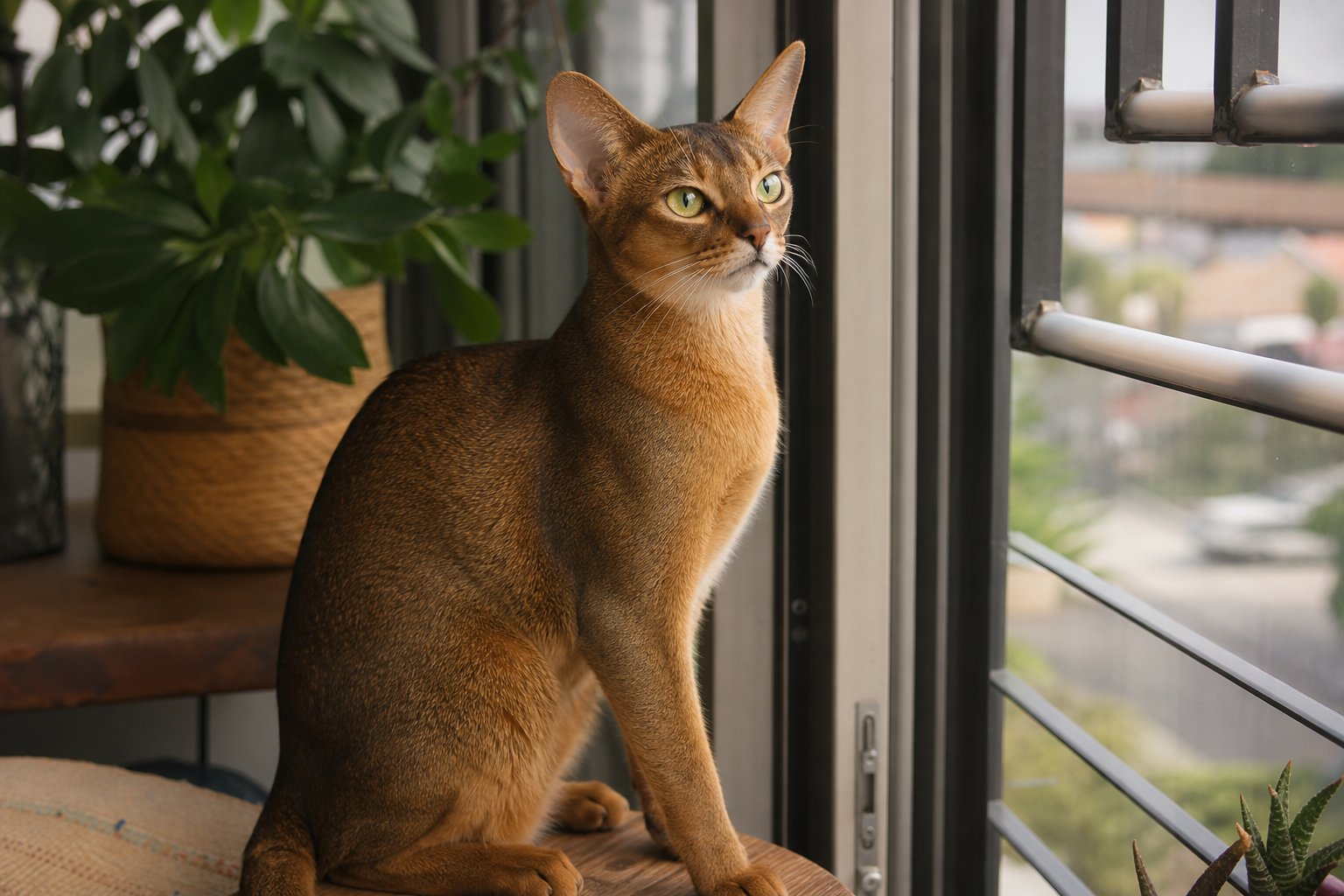
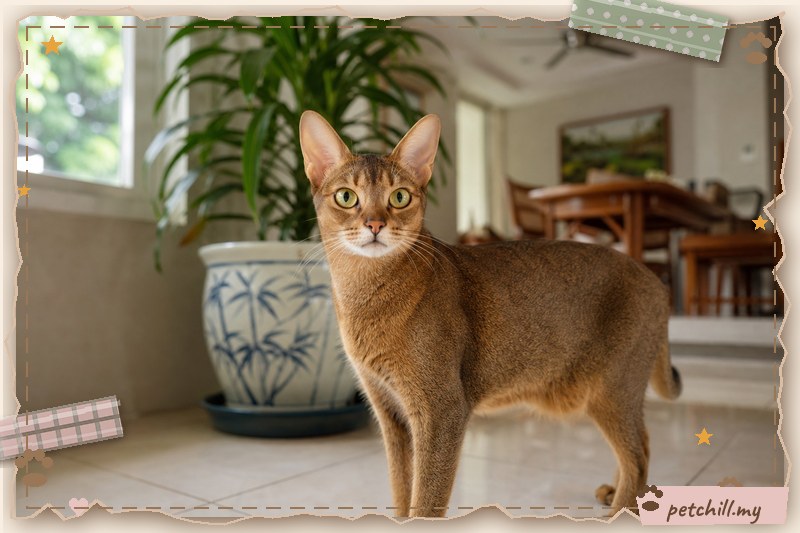
Quick answer: The Abyssinian is a 'colleague cat' — it wants to do things with you, not sleep beside you. Expect top-tier activity, lock-picking intelligence, strong people-orientation and a real weakness for long alone time. It suits households that are home often and enjoy daily interaction; it struggles in empty homes with no programme.
The five traits at a glance
The Abyssinian personality is usually summed up in five words: active, intelligent, curious, confident and people-oriented. Breed standards describe the cat as perpetually in motion while also highly invested in its humans. That combination is what makes the breed distinctive — and what makes it a poor match for some homes.
| Trait | What you see day to day | What it means for care |
|---|---|---|
| Very high activity | Patrols every high point in the house, from floor to wardrobe top | Three play sessions a day is a baseline, not a treat |
| Intelligent and curious | Opens doors, cupboards and taps; watches you operate things | Whole-home cat-proofing plus rotating puzzle toys |
| People-oriented | Sits on your desk while you work, follows you room to room | Cannot be left alone all day without a plan |
| Confident and bold | Investigates strangers rather than hiding | Low stress, but escape-proofing still matters |
| Gentle and talkative | Soft chirps and running commentary | Answer quietly; do not turn it into a noise loop |
In a Malaysian home, the activity trait has a practical consequence: ceiling fans, open windows and balcony grilles all become part of the cat's mental map. An Abyssinian will find the highest shelf in a Kuala Lumpur apartment within a day, so check that shelves, curtain rails and air-conditioner ledges can take the weight and that nothing breakable sits within reach.
Why 'dog of the cat world' is not just marketing
Major breed registries note that the Abyssinian retains a strong exploratory instinct and a high level of human involvement. It does not wait to be called — it inserts itself into whatever you are doing. If you are cooking, it is on the counter reporting on the ingredients. If you open a laptop, it chooses the centre of the keyboard. If you go to the bathroom, it waits at the door, not scratching, just monitoring.
The interaction style is closer to a dog's than a typical cat's: following, patrolling, and shared attention — looking at what you look at. Many individuals also have a signature pose of standing on hind legs with a front paw raised, as if ready for a high-five. People who want an independent cat that does its own thing may find this suffocating. People who want a home that feels occupied will find it one of the highest-return personalities in the cat world.
Intelligence in practice: the lock-picking level
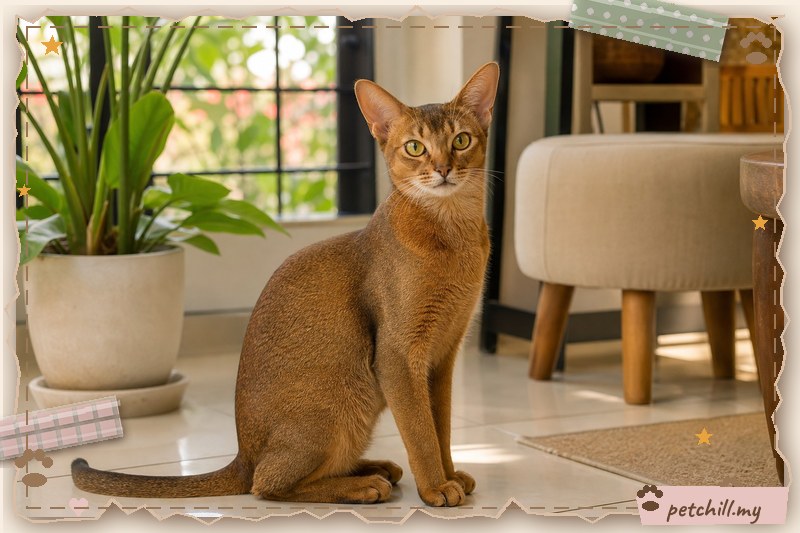
Abyssinian intelligence is not mystical. It breaks down into three observable lines.
- Observational learning. Many cats work out the logic of a window catch, a door handle or a cupboard latch after watching it operated for a few days. Cupboard-opening ability is widely recognised in the breed.
- Cue training. Sit, high-five and fetch are commonly teachable. Food drive is high and the number of repetitions needed is usually low.
- Environmental modification. To get a drink, the cat learns to nudge a tap. To reach food, it learns to lift a bin lid. To open a window, it learns to push a restrictor.
The practical meaning is simple: medicines, fragile items and cleaning products go into closed cupboards; the fridge gets a child lock or a second latch; bins have lids. The same intelligence is an education opportunity. Ten minutes of training a day is entertainment for an Abyssinian, and puzzle feeders, hidden-food games and rotating new cues are the standard way to discharge mental energy. A mentally tired Abyssinian is much calmer than a physically tired one.
Living with children, cats and dogs
With children, the breed tends to treat kids as large playmates: willing to run and chase, quick to forgive, and more likely to walk away than retaliate when hurt. Two conditions apply. First, teach children not to squeeze or restrain the cat — an Abyssinian's affection is close contact, not being held tight. Second, supervise games with children under five, who cannot match the cat's speed and jumping height.
With other cats, high social need makes the Abyssinian a social lubricant in a multi-cat home; it is usually the one inviting play. Pair it with a similarly active cat. Quiet or elderly cats can be pestered. With dogs, it generally does well with gentle dogs that lack a strong hunting drive, and 'dog and cat grooming each other' is a common outcome. In short, this is a social, activity-seeking breed: the more there is to do, the happier it is, and the worst case is being the only animal in a house where everyone leaves early and returns late.
The honest weakness: alone time and separation anxiety
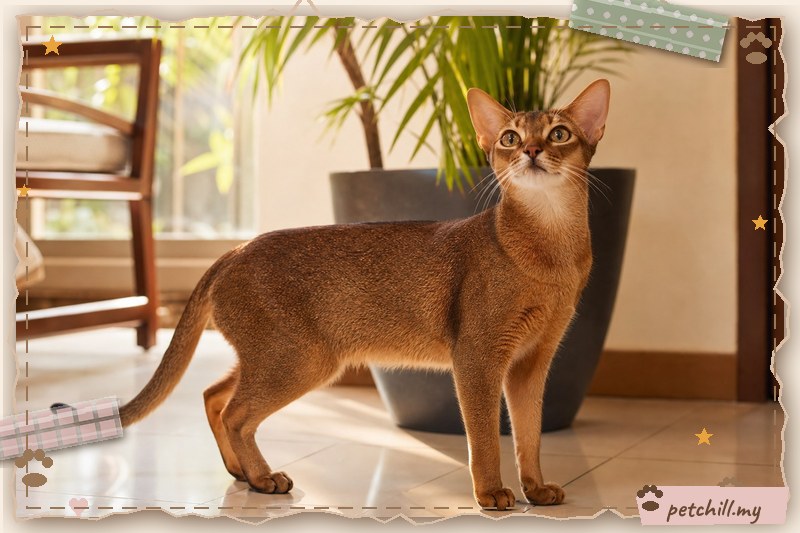
Separation anxiety is the breed's biggest personality shortfall. Its genetic setting is that of a group hunter; solitude is not a treat but a deficit. Individuals left alone eight to ten hours a day with no programme may show excessive vocalisation, more pushing things off counters, house soiling (rule out urinary disease first), and intense clinginess when you return.
Three practical lines of defence:
- Before you leave: fifteen minutes of play plus a puzzle feeder left out.
- During the day: a window perch for bird-watching and a timed feeder to break up the hours.
- For genuinely long-working households: seriously consider a companion cat.
Do not expect training to make an Abyssinian 'independent'. You can manage the programme; you cannot change the genetics.
Male versus female, and how to choose a cat
General observations, not rules: males tend to explore boldly, have weaker boundaries and mix easily with children and dogs; females tend to be alert and attentive, with a clearer sense of whom they have chosen as their person. Beyond sex, bloodline matters. Show lines and companion lines differ in activity level and in how they attach. Before buying, ask the breeder about the parents' daily style. Adopting an adult is the safest route because personality is already set: the cat that comes up and head-butts your hand and the cat that watches you from a corner will give you very different next ten years.
Designing a day for a colleague cat
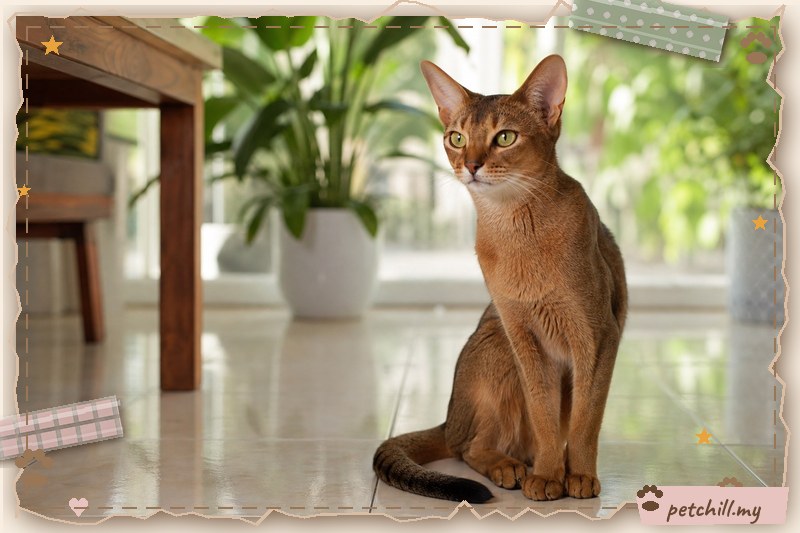
The right approach is a schedule. After the morning feed, a short play session to burn off sleep energy. Ten minutes of hunting simulation before you leave. An hour of floor-level interaction after you return, plus a quick teeth and ear check. A chase game before bed to close the day. Weekends add a training lesson or a new toy test — the learning window stays open for life.
Sleep arrangements matter too. Allow the cat into the bedroom, ideally with its own bed beside yours. Shutting an Abyssinian out completely produces a stronger stress response than in most breeds. The basic formula: Abyssinian wellbeing = hours of companionship × quality of programme. Get both right and you have a loyal shadow; get one wrong and you will see every consequence listed in the weakness section.
A training checklist you can start today
The Abyssinian is one of the breeds most worth training seriously. Three lessons, easy to harder, ten minutes a day each:
| Lesson | How to teach it | Time to see results | Practical value |
|---|---|---|---|
| 1. Recall | Shake a treat tin, reward when the cat comes; practise before meals | 3–7 days | A life-saving cue in an emergency and the first anti-escape lesson |
| 2. Entering the carrier | Keep the door open, move treats gradually inside, close for ten seconds then open | 1–2 weeks | Vet visits stop being a chase around the house |
| 3. High-five or sit | Lure a sit with a treat above the head; reward a paw touch | 1–2 weeks | Mental discharge and a party trick |
Three rules. First, positive reinforcement only: this breed responds to scolding with resentment and a shutdown, so interrupt and redirect instead, and reward immediately when the cat gets it right. Second, keep sessions short: stop at ten minutes while attention is still high. Third, keep cues consistent: everyone in the house uses the same word and hand signal, because the Abyssinian learns rules, not just movements, and will pick the loosest interpretation if the household is inconsistent.
The extra reward is that the training interaction itself is what the cat enjoys most — doing something together with its owner. That fills the social need more directly than buying ten more toys, and it closes the loop with the separation-anxiety advice above.
When to see a vet
Most Abyssinian behaviour is normal breed behaviour, but some signs need a veterinarian rather than a trainer. Book an appointment if your cat starts urinating outside the litter box, especially on soft surfaces — urinary disease must be ruled out before anyone calls it behavioural. See a vet if vocalisation becomes constant and distressed, if there is sudden weight loss despite a good appetite (thyroid and other conditions are worth checking), if the cat over-grooms to the point of bald patches or skin damage, or if appetite and activity drop sharply. Any sudden change in a normally confident, active cat is worth a check-up. For serious anxiety or aggression that does not improve with a programme, ask your vet about a referral to a qualified cat behaviourist.
A Malaysian household checklist
Malaysia's climate and housing shapes how this breed's personality plays out. In a Kuala Lumpur apartment, the main risks are open windows, balcony grilles and high ledges; an Abyssinian will test all three. In a Johor terrace house, the risk shifts to doors left ajar and car porches, so a secure entry routine matters. During the Penang rainy season, outdoor time is limited, so indoor puzzle rotation and vertical space become more important than ever. None of this requires special equipment — it requires a plan made before the cat makes one for you.
Bottom line
The Abyssinian is a high-input, high-return cat. It is intelligent enough to open things, social enough to need company, and active enough to need a daily programme. If your household is home often, enjoys interaction and can commit to ten minutes of training and three play sessions a day, this breed will reward you with a level of engagement few cats offer. If your home is empty from morning to night, choose a more independent breed or adopt a calm adult cat instead.
This article describes general breed tendencies; individual cats vary. It is not veterinary advice. For health or serious behaviour concerns, consult a licensed veterinarian in Malaysia.