
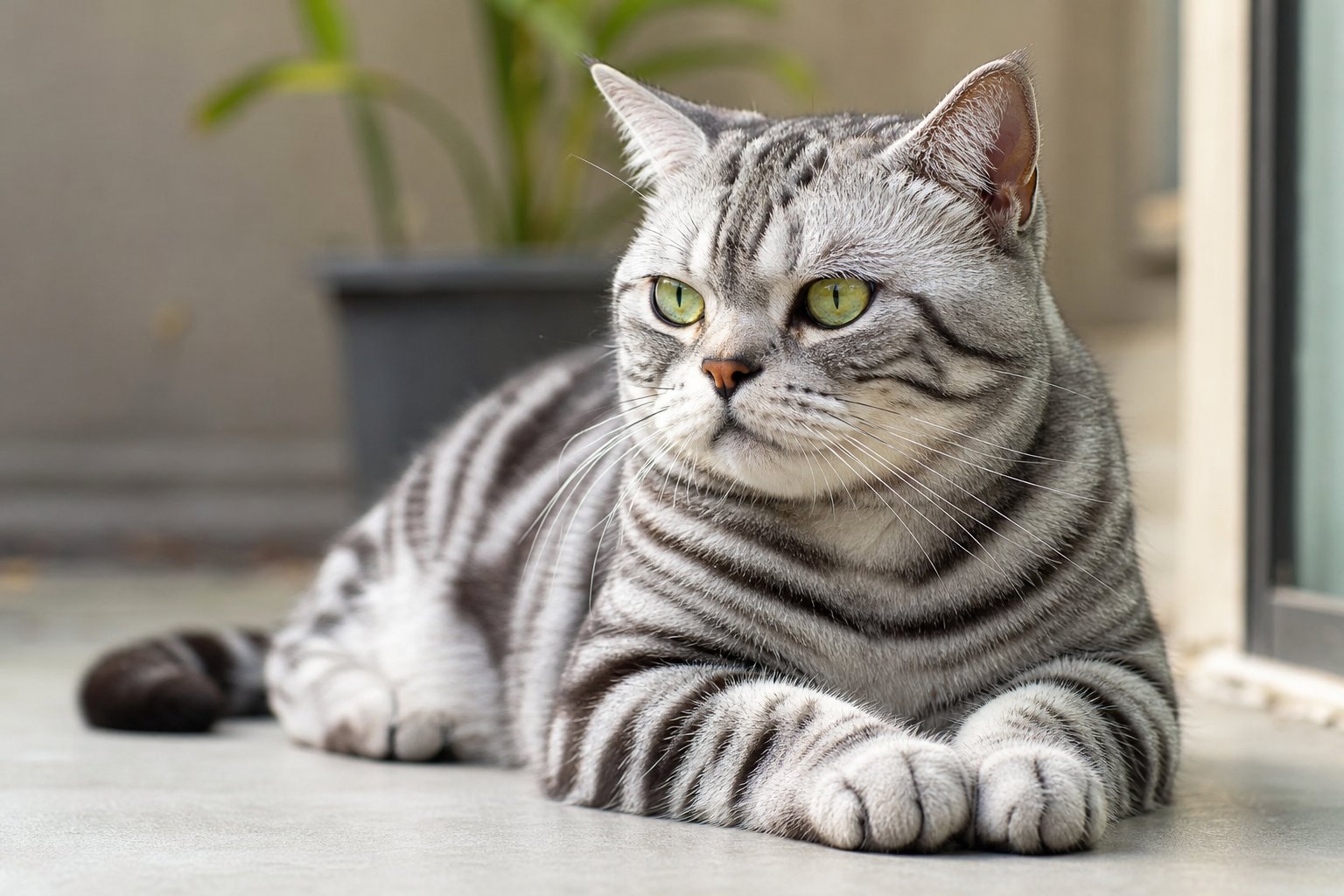
Quick answer
Adult American Shorthairs typically weigh 5–8 kg (male) and 4–5.5 kg (female), but the breed is muscular rather than simply large. The scale alone cannot tell you if your cat is healthy. Use a 9-point body condition score (BCS): ideal is 4–5, with ribs easy to feel under light pressure and a visible waist from above. Weigh monthly and track the trend.
Why weight numbers are only half the story
The American Shorthair is a working-cat breed with a sturdy, muscular build. Two cats of the same weight can look very different depending on muscle density and bone size. A muscular 6 kg male may be in ideal condition, while a 5 kg female carrying excess fat may already be overweight. This is why veterinarians rely on body condition scoring rather than breed weight tables alone.
In Malaysia, many cats live indoors in apartments or terrace houses with limited outdoor activity. That makes regular condition checks especially useful. A cat that looks "solid" may simply be well-muscled, or it may be carrying fat around the abdomen and ribcage. The only reliable way to tell is to put hands on the cat and compare against a consistent scale.
Typical adult weight ranges
| Sex | Common adult weight | Notes |
|---|---|---|
| Male | 5–8 kg | Larger-boned individuals may be slightly higher |
| Female | 4–5.5 kg | Muscle density matters more than the number |
These are general ranges, not targets. A cat at the lower end with good muscle tone can be healthier than a heavier cat with poor condition. Always combine weight with BCS and a monthly trend line.
Growth chart: kitten to adult
The table below gives general reference ranges. Individual kittens vary with bloodline and bone size.
| Age | Reference weight (kg) | Development focus |
|---|---|---|
| 8 weeks | 0.8–1.0 | Vaccination window |
| 3 months | 1.3–1.8 | Baby teeth changing |
| 6 months | 2.5–3.5 | Discuss neutering with your vet |
| 9 months | 3.5–4.5 | Growth rate slows |
| 12 months | 4.0–5.5 | Near adult weight |
| 2–3 years | Male 5–8 / female 4–5.5 | Muscle and chest continue to fill out |
Growth rate matters more than any single number. A healthy kitten gains roughly 70–100 g per week. If the curve stalls for two weeks or the kitten loses weight, book a vet visit rather than waiting for a catch-up spurt.
Body condition score: a 30-second home check
Vets commonly use a 9-point BCS. You can apply the same logic at home.
| Score | Ribs | Waist from above | Abdomen from side | Interpretation |
|---|---|---|---|---|
| 1–3 | Visible without touching | Very tucked | Strong tuck | Underweight — see a vet |
| 4–5 | Easy to feel with light pressure | Visible | Slight tuck | Ideal |
| 6–7 | Need firm pressure | Disappearing | Starting to sag | Overweight — adjust feeding |
| 8–9 | Cannot feel | No waist | Large sagging belly | Obese — vet-guided weight loss |
One common confusion is the primordial pouch, a loose flap of skin under the belly that swings when the cat walks. It is normal and not the same as fat. If ribs are still easy to feel, the pouch is likely just skin. If you need firm pressure to find ribs, fat is present. Both can exist at once, so check ribs and waist together.
How to weigh and measure at home
- Hold-and-weigh method: Weigh yourself, then weigh yourself holding the cat. The difference is the cat's weight, accurate to within a couple of hundred grams.
- Monthly photo check: Take a side view and a top view on the same date each month. Compare waistline and rib coverage.
- Neck circumference: A soft tape around the middle of the neck can help track short-term changes, but weight trend remains the main measure.
Pick a fixed day and a fixed condition, such as before breakfast, so the trend is comparable. A simple notebook or phone note is enough; no special app is required.
Feeding after neutering: the most common turning point
Neutering is often when weight gain begins. Metabolism tends to slow, and appetite may increase. A sensible approach is to start reducing daily calories by about 10% within two to four weeks after neutering, measured with a food scale rather than by eye. Alternatively, transition to a weight-management formula under veterinary guidance.
Avoid drastic cuts. Cats respond to sudden portion reduction with stress and increased begging. Instead, split the daily ration into more frequent small meals and use puzzle feeders so eating takes longer.
Safe weight loss rules
Cats are not small dogs. Rapid weight loss can trigger hepatic lipidosis (fatty liver), which is serious. Never starve a cat to make it slim.
Safe weight loss is about 0.5–2% of current body weight per week. In practice this usually means cutting calories by around 10%, feeding measured portions, and increasing activity gradually. Weigh every two to four weeks and aim for a smooth downward curve. If weight is not moving, do not cut further without veterinary advice.
Also rule out medical causes. Older cats that seem "too fat to move" may actually have joint pain and reduced activity, or thyroid disease. These need a vet assessment before any diet plan.
Exercise and environment for Malaysian homes
American Shorthairs are active, playful cats. Daily play sessions help prevent weight gain and boredom. In a Kuala Lumpur apartment, vertical space is especially valuable: a cat tree with platforms spaced 30–40 cm apart suits their leg length, and window perches provide safe enrichment.
In a Johor terrace house, watch for open doors and stairways. American Shorthairs can jump several times their shoulder height, so store dangerous items in closed cabinets rather than on tables. During the Penang rainy season, when outdoor time is limited, schedule two short indoor play sessions instead of one long one.
Comparison: American Shorthair vs British Shorthair
| Feature | American Shorthair | British Shorthair |
|---|---|---|
| Build | Muscular, athletic | Rounder, heavier-boned |
| Maturity | Around 1 year for weight; muscle to 2–3 years | Often slower, up to 3–5 years |
| Fat storage pattern | Abdomen and ribcage; waist disappears early | More evenly distributed |
| Early warning sign | Waistline fading | General rounding |
| Management tool | BCS plus monthly trend | BCS plus monthly trend |
Same weight does not mean same body. American Shorthairs tend to carry muscle in the shoulders and hind legs, and fat tends to show first around the waist and ribs. That makes the waistline the earliest practical warning sign.
When to see a vet
Book a veterinary appointment if you notice any of the following:
- Weight loss despite normal or increased appetite
- Weight gain despite measured feeding
- Ribs that cannot be felt at all, or a waist that has disappeared
- A kitten whose growth stalls for two weeks or who loses weight
- Sudden reluctance to move, jump or climb stairs
- Vomiting, diarrhoea or changes in thirst and urination
- Any planned weight-loss programme for an overweight cat
Your vet can confirm BCS, rule out thyroid or joint disease, and set a safe calorie target.
Practical checklist
- Weigh monthly on the same day, before breakfast
- Score BCS monthly using the 9-point table
- Use a food scale, not a cup, for dry food
- Reduce calories by about 10% after neutering, with vet advice
- Split meals and use puzzle feeders
- Schedule daily play, especially in rainy weather
- Track the trend, not a single reading
Frequently asked questions
What is the normal weight of an American Shorthair? Adult males commonly weigh 5–8 kg and females 4–5.5 kg. Larger-boned cats may exceed this. Because the breed is muscular, use body condition score alongside the scale rather than weight alone.
How can I tell if my American Shorthair is overweight? Use a 9-point body condition score. If you cannot feel the ribs with light pressure, or the waist disappears when viewed from above, the cat is heading overweight. Ideal is 4–5 out of 9.
At what age is an American Shorthair fully grown? Weight usually approaches adult level around 12 months, but muscle and chest width can keep developing until 2–3 years. Slower finishing growth is normal for this sturdy breed.
Can I put my cat on a strict diet to lose weight? Never starve a cat. Rapid weight loss risks fatty liver disease. Safe loss is about 0.5–2% of body weight per week, usually by cutting calories around 10%, with veterinary supervision and gradual exercise.
How much should a kitten gain each week? Healthy kittens gain roughly 70–100 g per week. At 8 weeks they are often 0.8–1 kg, and by 6 months around 2.5–3.5 kg. Stalled growth or weight loss warrants a vet visit.
Is a saggy belly fat or a primordial pouch? A primordial pouch is loose skin that swings when walking, and ribs remain easy to feel. Fat is a layer covering the ribs that needs firm pressure to find them. Both can exist together, so check ribs and waist.
This article is general information only and is not a substitute for veterinary advice. Weight-management plans, especially for overweight or growing cats, should be supervised by a licensed veterinarian.