
The short answer
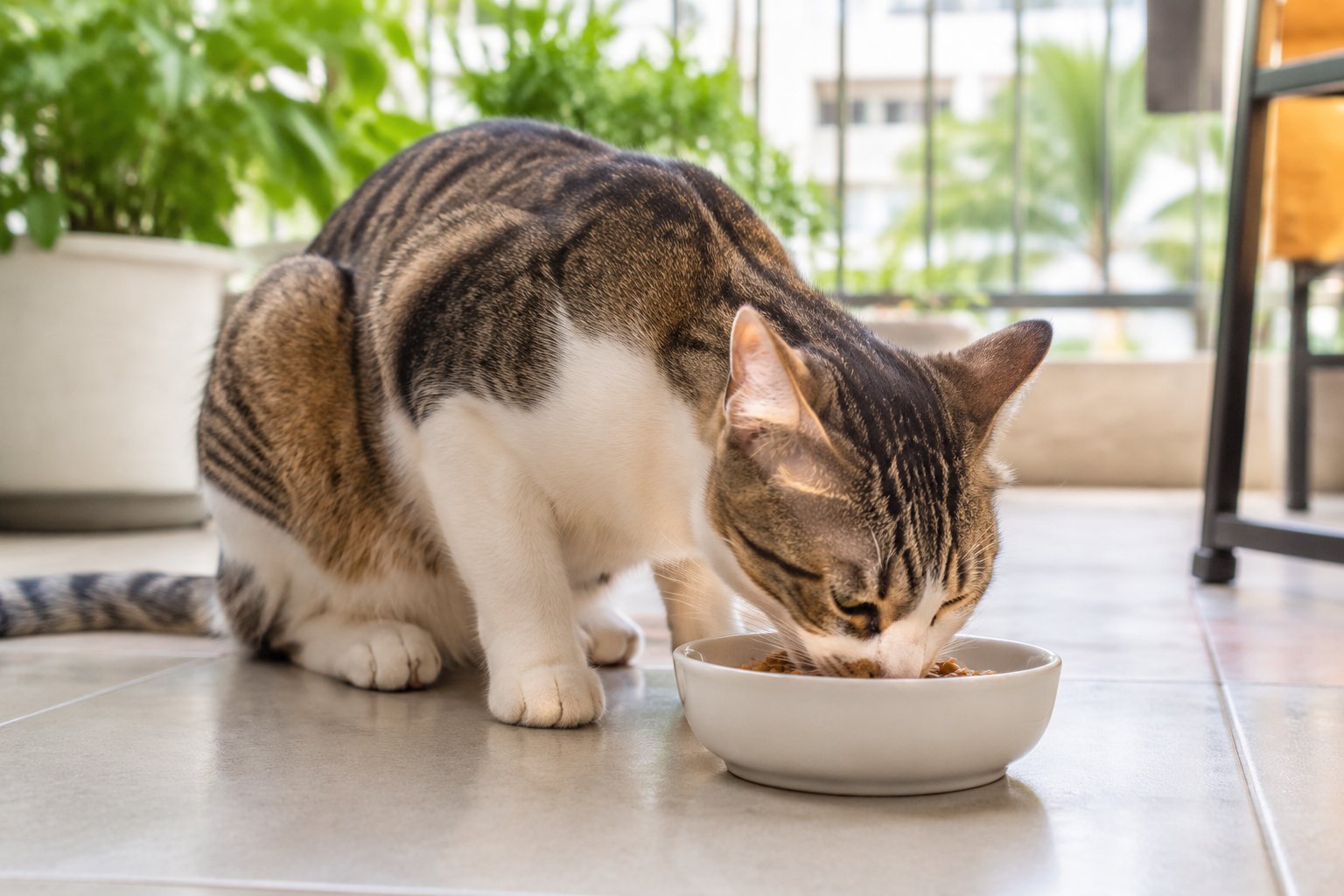
Halal cat food is simply cat food that avoids ingredients Muslims are not permitted to consume, such as pork and its derivatives, and is often produced under a recognised halal certification scheme. Your cat does not need halal food to thrive, but if you prefer to buy it, the practical steps are the same as for any cat food: confirm the certification, read the ingredient list, choose a complete and balanced diet, and feed the right amount for your cat's age, weight and body condition.
This guide walks through what halal certification means for pet food, how to read labels, how much to feed, how to switch foods safely, and when to involve your vet. It is written for Malaysian cat owners living in apartments, terrace houses and everywhere in between.
What halal means for cat food
Halal is an Arabic term meaning permissible under Islamic law. For food, it generally means the product does not contain prohibited substances such as pork, carrion, blood or alcohol used as an ingredient, and that any meat comes from animals slaughtered according to Islamic requirements.
For cat food, the concept is applied to the product you buy, not to the cat. Cats are not subject to religious dietary rules. The point of halal cat food is to let owners avoid handling and buying products that contain ingredients they consider impermissible, and to support businesses that follow halal standards.
In practice, halal cat food usually means:
- No pork, lard, pork fat, pork liver or other pork-derived ingredients.
- Meat from species that are halal, such as chicken, beef, lamb, fish and certain other animals.
- Slaughter and processing that meet halal requirements, where a certification scheme is involved.
- No alcohol or prohibited additives used as ingredients.
It is important to separate this from nutrition. A halal-certified food is not automatically a good food. Certification tells you about ingredients and process, not about protein quality, nutrient balance or digestibility. You still need to evaluate the diet on nutritional grounds.
How to read a halal cat food label
Labels are where most confusion happens. Pet food labelling rules vary between countries, and terms like "meat and animal derivatives" can hide the species. If halal status matters to you, read the label in this order.
1. Look for a recognised halal mark
A halal certification mark from a recognised body is the clearest signal. The mark should be printed on the packaging, not just mentioned in marketing text. Certification usually covers the manufacturing facility and the ingredients, and it should be traceable to a certificate. If you cannot find a mark, do not assume a product is halal just because it is chicken-flavoured.
2. Read the ingredient list, not the front of the pack
The front of the pack is marketing. The ingredient list is the factual part. Look for:
- Named meats: "chicken", "beef", "lamb", "salmon", "tuna".
- Named animal fats: "chicken fat", "beef fat".
- Generic terms: "meat and animal derivatives", "animal by-products", "poultry meal". These are not automatically non-halal, but they do not tell you the species, so you cannot confirm halal status from the label alone.
- Pork terms: "pork", "lard", "pork fat", "pork liver", "bacon", "ham", "pork digest".
- Additives and flavourings that may use alcohol as a carrier.
3. Check the complete and balanced claim
A food should state that it is "complete and balanced" for a specific life stage, such as growth, adult maintenance, or all life stages. This is a nutritional claim, separate from halal status. A halal-certified food that is not complete and balanced is a treat or a topper, not a sole diet.
4. Check the manufacturer's contact details
If the species is unclear or you cannot find a certificate, contact the manufacturer or importer. A reputable company should be able to tell you whether a product is halal-certified and which body certified it. Keep the batch number from the pack.
| Label feature | What it tells you | What to do |
|---|---|---|
| Halal certification mark | Product or facility certified by a recognised body | Verify the certifying body and certificate if unsure |
| Named meat (e.g. chicken) | Species is stated | Still check for pork-derived ingredients elsewhere |
| "Meat and animal derivatives" | Species not stated | Ask the manufacturer before assuming halal |
| "Complete and balanced" | Meets a nutritional standard for a life stage | Use as the base of the diet |
| "Complementary" or "treat" | Not a sole diet | Feed in small amounts alongside complete food |
| Pork, lard, pork fat | Pork-derived | Avoid if you want halal food |
Feeding amounts: how much to give
Feeding amount is the part owners most often get wrong, and it matters more to your cat's health than halal status. Cats are individuals. A small, sedentary indoor cat needs far less than a large, active cat.
Start with the pack, then adjust
Every complete food has a feeding guide based on body weight. Use it as a starting point, not a rule. Weigh your cat if possible, or ask your vet to weigh and body-condition score it. Then adjust based on results.
Body condition is the real guide
You should be able to feel your cat's ribs easily under a thin layer of fat, see a waist behind the ribs when viewed from above, and see a slight tummy tuck from the side. If ribs are hard to feel, the cat is likely overweight. If ribs, spine and hip bones are very prominent, the cat may be underweight.
A rough calorie guide
Most adult cats need roughly 200 to 300 calories per day, but this varies widely with weight, age, neuter status and activity. Growing kittens, pregnant or nursing queens, and very active cats need more. Senior cats and indoor lap cats often need less. Your vet can calculate a more precise target.
Wet food, dry food or both
Wet food is useful in Malaysia's hot climate because it adds water, which supports urinary and kidney health. Dry food is convenient and can be left out briefly, but it is calorie-dense and easy to overfeed. Many owners feed a mix: a measured portion of wet food plus a measured portion of dry food, with the total kept within the daily calorie target.
A simple daily routine
- Morning: measured wet food portion.
- Midday: fresh water, no food.
- Evening: measured wet or dry portion.
- Treats: no more than about 10 per cent of daily calories.
- Fresh water: always available, changed daily.
Switching to a halal cat food safely
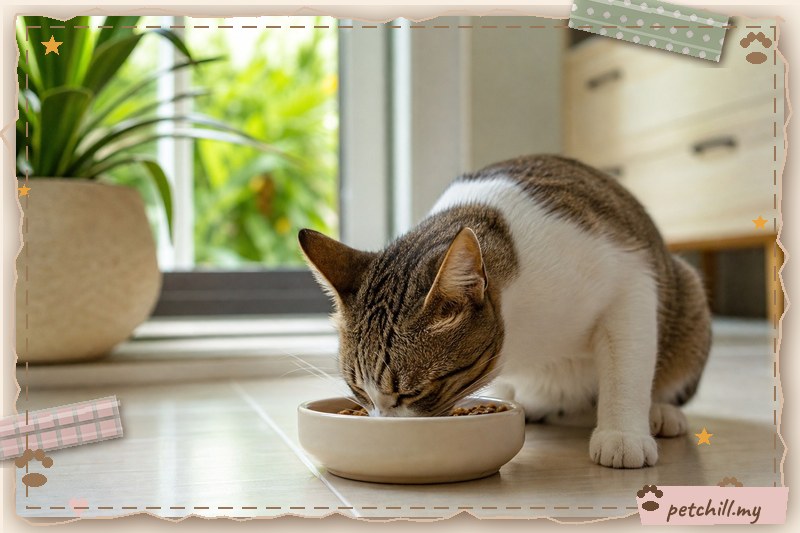
Cats are creatures of habit and can be suspicious of new food. A sudden switch can cause refusal or digestive upset. Transition gradually over about seven days.
| Day | Old food | New food |
|---|---|---|
| 1-2 | 75% | 25% |
| 3-4 | 50% | 50% |
| 5-6 | 25% | 75% |
| 7 | 0% | 100% |
If your cat has a sensitive stomach, extend each stage. If your cat refuses the new food, slow down and mix a little warm water into wet food to release aroma. Do not starve a cat to force a switch; cats can become ill if they stop eating for more than a day or two. If your cat refuses food for more than 24 hours, contact your vet.
Common mistakes to avoid
- Assuming chicken-flavoured means halal. Flavour names do not guarantee the absence of pork-derived ingredients or non-halal processing.
- Trusting the front of the pack. Read the ingredient list and look for a certification mark.
- Feeding by eye. Measure portions with a scale or measuring cup, especially for dry food.
- Free-feeding dry food all day. This is a common cause of obesity in indoor cats.
- Forgetting water. Wet food helps, but clean water must always be available.
- Changing foods abruptly. Transition over a week.
- Treating "halal" as a nutrition claim. It is not.
Practical Malaysian contexts
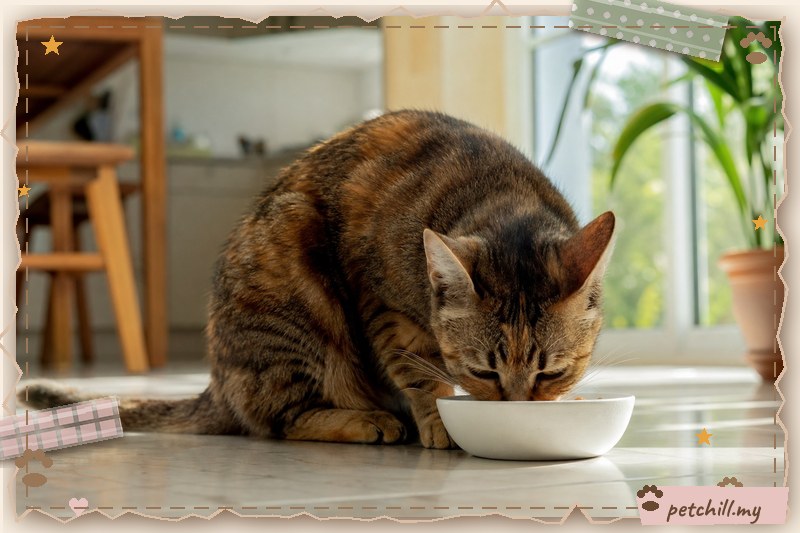
In a Kuala Lumpur apartment, space is limited and cats are often indoors. Indoor cats tend to be less active, so portion control and daily play matter. A measured wet food meal in the morning and a measured dry portion in the evening, with fresh water in two places, works well in a small flat. Keep the food away from the litter tray and direct sunlight.
In a Johor terrace house, cats may have more space and sometimes access to a covered patio or garden. That can mean more activity, but also more opportunity to scavenge. Keep food indoors, store dry food in an airtight container, and check that neighbours or visitors are not feeding your cat extra meals. In both settings, the same rule applies: measure the total daily food and adjust to body condition.
When to see a vet
Contact a veterinarian if your cat shows any of the following:
- Refusing food for more than 24 hours.
- Vomiting or diarrhoea that lasts more than a day or two, or is repeated.
- Noticeable weight loss or weight gain.
- Difficulty urinating, straining in the litter tray, or blood in the urine. This is urgent, especially in male cats.
- Persistent scratching, hair loss or skin problems that may relate to diet.
- Lethargy, hiding or a change in behaviour.
- A suspected allergic reaction, such as facial swelling or difficulty breathing. Seek urgent care.
A vet can also help you choose a suitable diet if your cat has kidney disease, diabetes, allergies, urinary problems or other conditions. Prescription diets are chosen for medical reasons, and halal status should be discussed with the vet and manufacturer rather than assumed.
Building a halal cat food routine that works
A good routine is simple and repeatable. Decide on a complete wet food and a complete dry food that suit your cat and your budget, confirm their halal status if that matters to you, and set a daily calorie target with your vet. Measure every meal, keep treats small, provide fresh water, and check body condition monthly. Record what you feed and how much, so you can spot changes quickly. If you change brands, transition gradually and watch for digestive upset. If your cat is healthy, eating well and maintaining a good body condition, the routine is working.
Quick checklist before you buy
- Is there a recognised halal certification mark on the pack?
- Does the ingredient list name the meat species?
- Are there any pork-derived ingredients?
- Does the food state "complete and balanced" for your cat's life stage?
- Do you know the daily calorie target for your cat?
- Can you measure portions accurately?
- Is fresh water always available?
- Do you have a plan for a gradual transition?
Bottom line
Halal cat food is a personal choice about ingredients and sourcing, not a nutritional requirement for cats. The healthiest approach is to choose a complete and balanced diet, feed the right amount, keep your cat lean and hydrated, and ask your vet when something changes. If halal status matters to you, verify the certification and read the label carefully rather than relying on flavour names or marketing.
This article is general information only and is not a substitute for veterinary advice. Always consult a licensed veterinarian about your cat's diet and health.
Related reading
- Cat Food Guide Malaysia 2026: How to Choose Dry, Wet & Prescription Food
- Best Halal Cat Food in Malaysia: A Practical Buying Guide
- Cat Food in Malaysia: How to Read the Label, Compare Protein and Budget Monthly
- Best High-Protein Cat Food in Malaysia: How to Choose (2025 Guide)
- Best Homemade Cat Food for Cats in Malaysia: A Practical Vet-Informed Guide
- Best Raw Cat Food for Cats in Malaysia: A Practical Buying Guide
- Dry Cat Food Feeding Guide for Cats: How Much, How Often and How to Do It Right
- Dry Cat Food for Cats in Malaysia: A Practical Feeding Guide
- Halal Cat Food for Cats in Malaysia: What It Really Means and How to Choose
- Homemade Cat Food Feeding Guide for Cats: A Practical Malaysian Owner's Handbook
- Homemade Cat Food for Cats in Malaysia: A Practical, Vet-Informed Guide

