
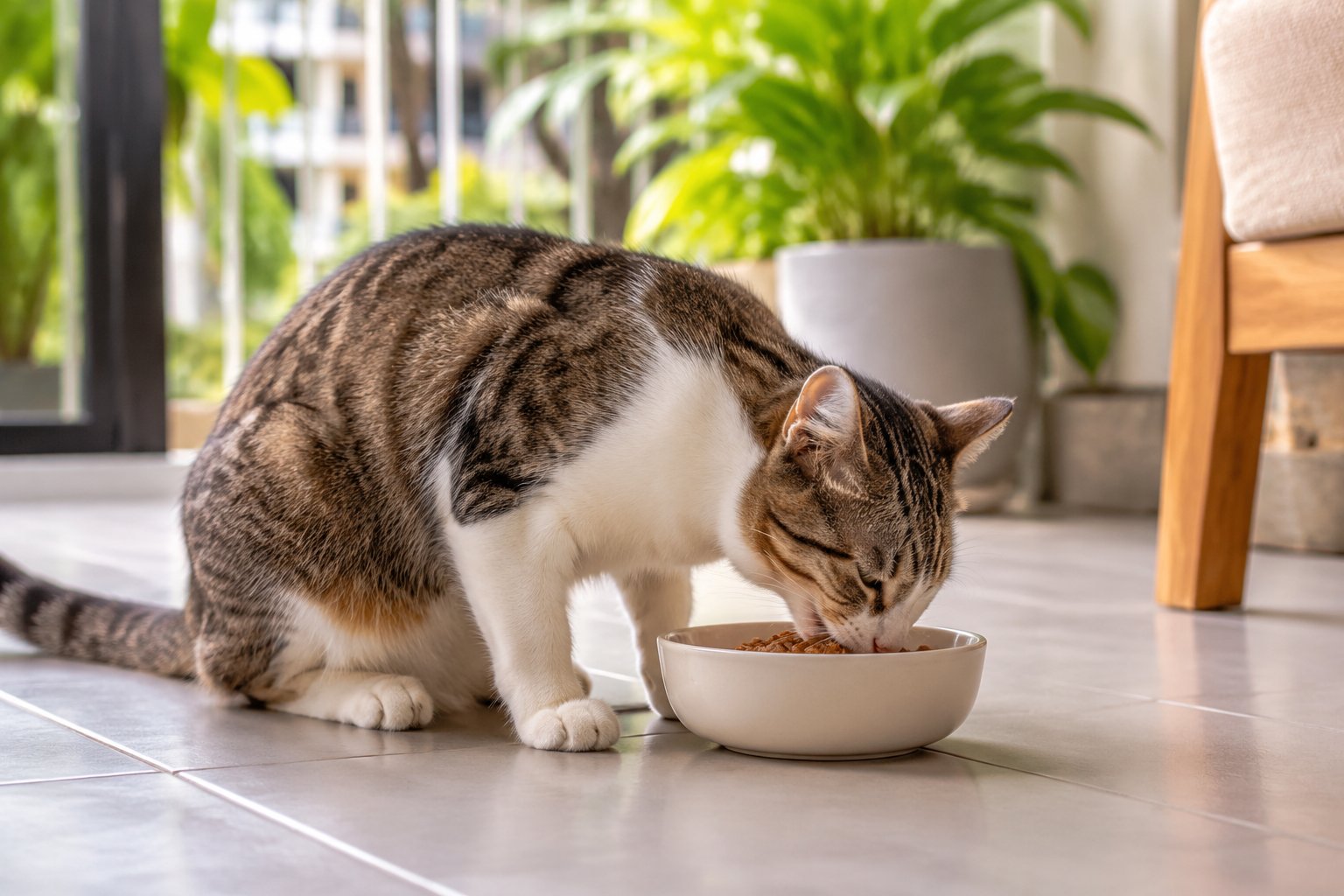
Start with a body check, not a bag of food
Weight control cat food is a tool, not a default. Before you buy a diet labelled "light", "weight control" or "reduced calorie", confirm that your cat is actually carrying excess body fat. Many owners mistake a large frame or a thick winter coat for obesity, while others miss real weight gain because the cat still jumps and plays.
The simplest at-home check is body condition scoring. Stand behind your cat and run your hands along both sides of the ribcage. You should feel the ribs easily, like the bones on the back of your hand, without pressing hard. Look at your cat from above: there should be a visible waist behind the ribs. From the side, the belly should tuck up slightly towards the hind legs. If you cannot feel the ribs, or the waist has disappeared, your cat is likely overweight and a weight control plan is worth discussing with your vet.
Weighing alone is less useful than body condition, because ideal weight varies with breed and frame. A large male cat may be healthy at 6 kg while a small female may be overweight at 4.5 kg. Use a kitchen scale for the cat and record the number monthly, but judge progress with both weight and body shape.
Why weight control matters for Malaysian cats
Overweight cats face higher risks of diabetes, joint strain, skin problems, breathing difficulty and anaesthetic complications. Indoor lifestyles are a major factor. In a Kuala Lumpur apartment, a cat may have limited space to run, and the heat and haze can discourage daily outdoor activity. In a Johor terrace house, a cat may roam the compound but still spend most of the day sleeping indoors.
Neutering also changes energy needs. Desexed cats often need fewer calories than entire cats, yet many continue eating the same amount. If your cat was neutered recently, ask your vet about a suitable maintenance plan rather than waiting for weight gain to appear.
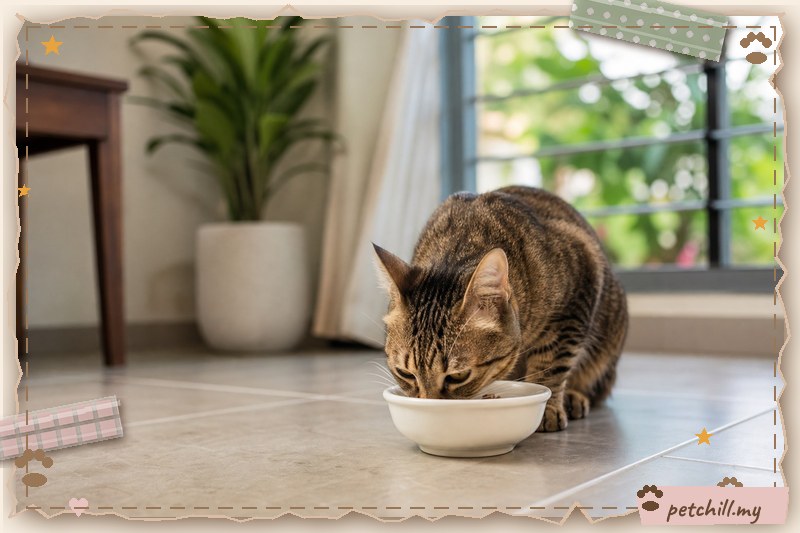
How to choose a weight control cat food
There is no single best brand. Look at the label and compare products on facts, not marketing words.
| What to check | Why it matters | What to look for |
|---|---|---|
| Calorie content | Weight loss depends on total calories, not volume | A stated kcal per 100 g or per can; compare products on the same basis |
| Protein level | Helps preserve muscle during weight loss | A named animal protein source and a guaranteed analysis that suits your cat's health |
| Fat level | Fat is calorie-dense | Lower fat than your cat's current diet, but not so low that the diet is unpalatable |
| Fibre | Can improve fullness | Moderate fibre from sources such as beet pulp or cellulose; too much may cause loose stool |
| Feeding guide | Gives a starting point | A guide based on target weight, not just current weight |
| Life stage | Nutrient needs differ | "Adult maintenance" for most adults; senior or veterinary diets only with advice |
| Wet or [dry | Water](/articles/wet-vs-dry-food-malaysia "mylink") content affects volume and cost | Either can work; compare calories per gram and your cat's preference |
Be cautious with "light" products that do not state calories. A food can be lower in fat but still calorie-dense. If the label is unclear, ask the retailer or your vet for the calorie content per 100 g. Local prices vary widely, so compare cost per 100 kcal rather than cost per bag.
Prescription weight loss diets are stronger tools for cats with health problems or severe obesity. They should be used under veterinary supervision because they are formulated for specific conditions and can be inappropriate for healthy cats.
Set a daily calorie target
Your vet can estimate your cat's ideal weight and daily calorie needs. A common starting point for weight loss is roughly 80% of the calories needed at ideal weight, but this must be individualised. Do not guess for cats with diabetes, kidney disease, heart disease or a history of liver problems.
Once you have a daily calorie target, convert it into food weight. If the food provides 350 kcal per 100 g, a 200 kcal daily target equals about 57 g of dry food. For wet food, use the kcal per can or pouch. A kitchen scale is more accurate than a measuring cup, especially for dry food, because kibble size and packing vary.
Divide the daily amount into at least two meals. Three or four smaller meals can help cats that beg constantly. If you use both wet and dry food, calculate the calories from each and subtract them from the total.

Transition gradually and measure every meal
Sudden diet changes cause digestive upset. Mix the new weight control food with the old food over 7–10 days, increasing the new food's share slowly. If your cat refuses the new diet, do not starve them into acceptance. Cats can develop a dangerous liver condition if they stop eating for several days. Try warming wet food slightly, offering a different texture, or asking your vet for an alternative.
Measure every meal and remove leftovers after 20–30 minutes. Free-feeding is the most common reason weight loss stalls. If you have children or other family members, write the feeding plan on the fridge so nobody adds extra meals.
Treats count. Keep treats to no more than 10% of daily calories, or replace them with small pieces of the weight control food taken from the daily ration. Avoid human foods such as bread, rice and fried snacks, which are calorie-dense and unbalanced.
Multi-cat homes: stop the food thief
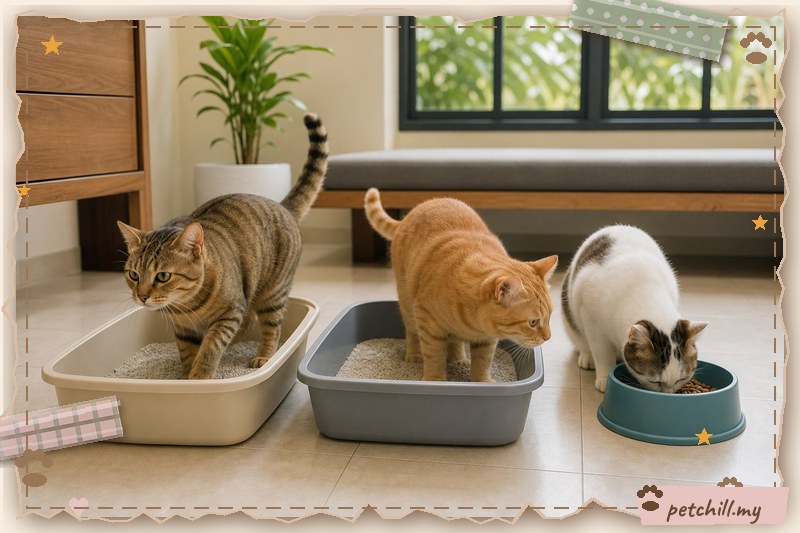
In a multi-cat household, one cat may eat most of the food while another loses weight. Separate cats at feeding time in different rooms, or use microchip-activated feeders that open only for the correct cat. Feed meals at set times and pick up bowls afterwards. If a thin cat is being bullied away from food, address the social dynamic as well as the diet.
Puzzle feeders and scatter feeding can slow fast eaters and provide enrichment. For cats on weight control food, use part of the daily ration in a puzzle feeder rather than adding extra food.
Exercise and enrichment
Diet does the heavy lifting, but activity helps preserve muscle and improves mood. Short, frequent play sessions are better than one long session. Try a wand toy for 5–10 minutes before meals, and rotate toys to prevent boredom. Food puzzles, cardboard boxes and cat trees encourage movement indoors.
In hot Malaysian weather, play during cooler parts of the day and always provide fresh water. Never restrict water. If your cat is very overweight, avoid high-impact jumping games until some weight is lost, and ask your vet about safe activity.
Track progress and adjust
Weigh your cat monthly on the same scale and record body condition every 2–4 weeks. A safe rate of loss is about 0.5–1% of body weight per week. For a 5 kg cat, that is roughly 25–50 g per week, or 100–200 g per month. If your cat loses weight much faster, increase the ration slightly and speak to your vet. If there is no change after 4–6 weeks of accurate measuring, review calories, treats and sneaky extra meals before cutting food further.
Plateaus are normal. Weight loss is not linear, and small measurement errors add up. Recheck the calorie content of the food, confirm the scale is accurate, and ask your vet to reassess body condition.
When to see a vet
See a vet before starting a weight loss plan if your cat has diabetes, kidney disease, heart disease, arthritis, a history of hepatic lipidosis, or is pregnant or nursing. Seek veterinary advice promptly if your cat stops eating for more than 24 hours, vomits repeatedly, becomes lethargic, or loses weight rapidly. Also see a vet if weight gain is sudden, if the belly looks bloated, or if your cat shows increased thirst and urination, which can signal diabetes. Kittens and senior cats should have a health check before any diet change.
Practical feeding checklist
- Confirm body condition with your vet or a reliable scoring chart.
- Record current weight and target weight.
- Choose a diet with a clear calorie statement.
- Calculate daily calories and convert to grams or cans.
- Weigh food with a kitchen scale.
- Split into two or more meals.
- Transition over 7–10 days.
- Limit treats and account for them in calories.
- Separate cats at feeding time.
- Weigh monthly and adjust every 2–4 weeks.
- Stop free-feeding and remove leftovers.
A realistic Malaysian routine
In a Penang rainy season, outdoor activity may drop, so indoor play becomes more important. In a Kuala Lumpur apartment, use vertical space such as shelves and cat trees to encourage movement without needing a garden. In a Johor terrace house, check that neighbours are not feeding your cat, because extra meals from outside will undermine any weight control plan.
Weight control is a long-term project, not a quick fix. Most cats need several months to reach a healthy weight, and some need a maintenance plan for life. The goal is steady, measurable progress with veterinary support, not a perfect week.
This article is general information only and is not a substitute for veterinary advice. Always consult a licensed veterinarian in Malaysia before changing your cat's diet, especially if your cat has a medical condition.
Related reading
- Cat Food Guide Malaysia 2026: How to Choose Dry, Wet & Prescription Food
- Best Food for Picky Cats in Malaysia: A Practical Feeding Guide
- Food for Picky Cats: A Feeding Guide for Malaysian Cat Owners
- How to Choose Homemade Cat Food for Cats: A Malaysian Guide
- Best Hairball Control Food for Cats in Malaysia: A Practical Buying Guide
- Best High-Protein Cat Food in Malaysia: How to Choose (2025 Guide)
- Cat Care in Malaysia: A Complete Guide for New and Experienced Owners
- Food for Picky Cats in Malaysia: A Practical Feeding Guide

