
Quick answer
Urinary care cat food is a diet designed to support bladder and urinary tract health. It usually works by controlling minerals, managing urine pH, and encouraging higher water intake. Feed it only when a vet recommends it, transition slowly over 7–10 days, and make sure your cat drinks plenty of fresh water. Wet food is generally better for hydration than dry kibble.
What is urinary care cat food?
Urinary care cat food is a category of cat food formulated to reduce the risk of urinary tract problems or to support cats already diagnosed with a condition such as feline lower urinary tract disease (FLUTD), struvite crystals, or bladder inflammation.
These diets typically do one or more of the following:
- Control minerals such as magnesium, phosphorus, calcium and sodium to reduce crystal formation.
- Manage urine pH so it stays in a range that discourages struvite or calcium oxalate crystals.
- Increase water intake by being more palatable, higher in moisture (wet diets), or formulated to encourage drinking.
- Support bladder lining with ingredients like omega-3 fatty acids or glycosaminoglycans in some formulas.
There are two broad types:
- Veterinary prescription urinary diets – used to dissolve certain stones or manage diagnosed disease. These must be used under vet supervision.
- Over-the-counter urinary maintenance diets – marketed for prevention or general urinary support in healthy cats. They are not a substitute for veterinary treatment.
When does a cat need urinary care food?
A vet may recommend urinary care food if your cat has:
- A history of struvite crystals or stones
- Calcium oxalate stones (dietary management differs from struvite)
- FLUTD or recurrent bladder inflammation
- Idiopathic cystitis (bladder inflammation with no obvious cause)
- Had a urinary blockage and needs long-term prevention
- Been advised preventive nutrition due to breed, age, or lifestyle risk factors
It is important to understand that not all urinary problems are the same. A diet that helps dissolve struvite stones is not the same as one designed to prevent calcium oxalate stones. This is why a veterinary diagnosis matters before you choose a food.
Signs your cat may have a urinary problem
Watch for these signs and act quickly:
- Frequent trips to the litter box with little or no urine
- Crying or straining while urinating
- Blood in the urine
- Urinating outside the litter box
- Licking the genital area more than usual
- Drinking more water than usual
- Reduced appetite, lethargy, or hiding
Male cats are at higher risk of urethral blockage, which is a life-threatening emergency. If your male cat is straining and producing little or no urine, see a vet immediately.
Wet vs dry urinary care food
| Feature | Wet urinary care food | Dry urinary care food |
|---|---|---|
| Moisture content | Usually 70–80% | Usually 6–10% |
| Hydration support | High | Lower; relies on drinking |
| Convenience | Less convenient; must be refrigerated after opening | Easy to store and serve |
| Cost per day | Generally higher | Generally lower |
| Dental effect | Minimal | Some kibble may help with tartar |
| Palatability | Often high | Varies |
| Best for | Cats prone to crystals, low drinkers, FLUTD | Cats who refuse wet food, multi-cat homes |
Many vets recommend wet food as the foundation of urinary care because increased water intake dilutes urine and reduces crystal concentration. Dry urinary diets can still be effective, but they depend on your cat actually drinking enough water.
A practical approach for many Malaysian homes is to feed a mix: a wet urinary diet as the main meal and a small portion of dry urinary kibble for convenience or overnight. Ask your vet which combination suits your cat's condition.
How much to feed
Feeding amounts depend on the food's calorie density and your cat's weight, age, and activity level. Always follow the label as a starting point, then adjust based on body condition.
General guidelines:
- Weigh your cat regularly, ideally monthly.
- Measure portions with a kitchen scale or measuring cup rather than estimating.
- Split meals into 2–3 feedings per day for better digestion and satisfaction.
- Adjust gradually if your cat is gaining or losing weight.
- Account for treats – treats should be no more than about 10% of daily calories.
A typical adult cat needs roughly 40–60 kcal per kilogram of body weight per day, but this varies widely. Your vet can calculate a target for your cat, especially if weight loss or weight gain is needed.
How to transition to urinary care food
Cats are notoriously suspicious of new food. A slow transition reduces stomach upset and refusal.
7–10 day transition plan:
| Day | Old food | New food |
|---|---|---|
| 1–2 | 75% | 25% |
| 3–4 | 50% | 50% |
| 5–6 | 25% | 75% |
| 7–10 | 0% | 100% |
Tips to improve acceptance:
- Warm wet food slightly to release aroma.
- Mix a little of the old food into the new food.
- Feed at consistent times in a quiet place.
- Avoid free-feeding dry food if you need to monitor intake.
- If your cat refuses for more than 24–48 hours, contact your vet. Cats should not go without food for long.
Water: the most important part of urinary care
Increasing water intake is one of the most effective ways to support urinary health. Dilute urine reduces the concentration of minerals that form crystals and helps flush the bladder.
Ways to boost water intake:
- Feed wet food – it can provide 70–80% moisture.
- Offer multiple water bowls in different rooms.
- Try a pet water fountain – many cats prefer running water.
- Keep water fresh and clean bowls daily.
- Add a little warm water to wet food or dry kibble.
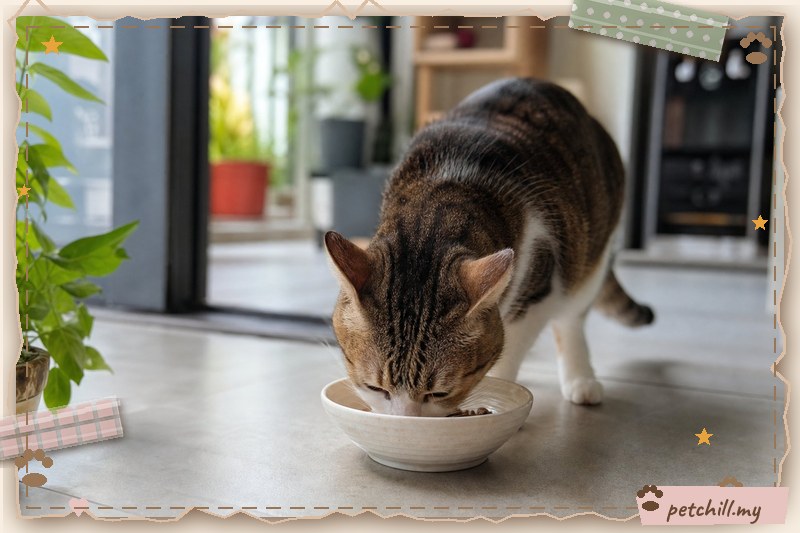
- Use wide, shallow bowls to avoid whisker fatigue.
- Place bowls away from the litter box and food.
In Malaysia's hot and humid climate, cats can lose water through panting and evaporation. Indoor cats in air-conditioned rooms may drink less, so wet food and multiple water stations are especially useful.
Environmental and litter box factors
Urinary health is not only about food. Stress and litter box habits play a big role, especially in idiopathic cystitis.
- Provide one litter box per cat plus one extra.
- Keep boxes clean – scoop daily.
- Use unscented litter and avoid sudden changes.
- Place boxes in quiet, accessible locations.
- Avoid overcrowding and provide vertical space and hiding spots.
- Keep a consistent routine – cats are creatures of habit.
In a Kuala Lumpur apartment, for example, a cat may be stressed by noise, limited space, or a single litter box near a busy doorway. Adding a second box in a quiet corner and a scratching post can reduce stress-related bladder flares. In a Johor terrace house, cats may have more space but could be exposed to neighbourhood cats through windows, which can also cause territorial stress.
Common mistakes to avoid
- Self-prescribing prescription diets without a diagnosis.
- Mixing urinary diets with other foods that alter urine pH – this can reduce effectiveness. Ask your vet before adding supplements or treats.
- Feeding urinary food to kittens or pregnant cats – these diets are not formulated for growth.
- Ignoring water intake – dry food alone may not be enough.
- Delaying vet care when signs appear – especially straining in male cats.
- Changing food too quickly – this causes refusal and stomach upset.
Special situations
Multi-cat homes: If one cat needs a urinary diet and others do not, feed separately or use microchip feeders. Free-feeding a urinary diet to all cats may not be appropriate, especially for kittens or cats with other conditions.
Cats with kidney disease: Urinary diets and kidney diets are different. Some cats have both urinary and kidney issues, and your vet will need to choose a diet that balances both. Do not switch diets without advice.
Overweight cats: Weight loss can reduce urinary risk, but weight loss must be gradual. Ask your vet for a safe plan.
Senior cats: Older cats may have reduced kidney function and different nutritional needs. Regular check-ups help catch problems early.
When to see a vet
See a vet promptly if your cat:
- Strains to urinate or produces little/no urine
- Cries while urinating
- Has blood in the urine
- Urinates outside the litter box suddenly
- Drinks and urinates much more than usual
- Has a reduced appetite or seems lethargic
- Has a history of urinary problems and shows new signs
Male cats straining with no urine is an emergency. Do not wait.
Vet disclaimer
This article is for general information only and is not a substitute for veterinary advice. Urinary conditions can be serious. Always consult a licensed veterinarian for diagnosis and a feeding plan tailored to your cat.
Frequently asked questions
What is urinary care cat food? It is a diet formulated to support bladder and urinary tract health, usually by controlling minerals like magnesium and phosphorus, managing urine pH, and encouraging higher water intake. Some are veterinary prescription diets; others are over-the-counter maintenance formulas.
Does my cat need urinary care food? Only if a vet has diagnosed a urinary issue or advised prevention. Healthy cats generally do well on a complete balanced diet with good hydration. Ask your vet before switching, especially if your cat has kidney disease or other conditions.
Is wet or dry urinary care food better? Wet food is usually better for hydration because it contains far more moisture. Dry urinary diets can still help but rely on your cat drinking enough water. Many vets recommend wet or a mix of wet and dry.
How do I switch my cat to urinary care food? Transition gradually over 7–10 days, mixing increasing amounts of the new food with the old. Sudden changes can cause stomach upset or refusal. Warm wet food slightly and feed at consistent times to encourage acceptance.
Can I feed urinary care food to healthy cats? Over-the-counter urinary maintenance diets may be fine for healthy adult cats, but prescription urinary diets should only be used under veterinary guidance. They are not suitable for kittens, pregnant cats, or cats with certain other conditions.
How much water should a cat drink? Roughly 40–60 ml per kilogram of body weight per day, including water in food. Cats on dry food need to drink more. Offer fresh water in multiple bowls, consider a fountain, and add wet food to boost intake.
Related reading
- Cat Food Guide Malaysia 2026: How to Choose Dry, Wet & Prescription Food
- Best Urinary Care Cat Food in Malaysia: How to Choose (2025 Guide)
- Cat Care in Malaysia: A Complete Guide for New and Experienced Owners
- Food for Picky Cats: A Feeding Guide for Malaysian Cat Owners
- How to Choose Urinary Care Cat Food for Cats: A Malaysian Owner's Guide
- Urinary Care Cat Food for Cats in Malaysia: A Practical Guide
- Wet vs Dry Cat Food in Malaysia: Water, Cost and How to Choose
- Best Food for Picky Cats in Malaysia: A Practical Feeding Guide
- Best Hairball Control Food for Cats in Malaysia: A Practical Buying Guide
- Best High-Protein Cat Food in Malaysia: How to Choose (2025 Guide)
- Best Hypoallergenic Cat Food in Malaysia: A Practical Guide for Itchy, Scratching Cats
- Best Weight Control Cat Food in Malaysia: A Practical Buying Guide

