
The short answer
A multi-cat household is not simply one cat routine multiplied. It is a resource-management system. Cats are solitary hunters that tolerate company when territory, food, water, litter and resting spots are plentiful and predictable. Get those basics right and most pairs settle into peaceful co-existence, sometimes friendship. Get them wrong and you get spraying, hiding, blocked litter trays, over-grooming and vet bills.
This guide walks through the practical setup for Malaysian homes, from Kuala Lumpur apartments to Johor terrace houses, plus how to introduce a new cat and when behaviour changes need a vet.
Start with resources, not affection
Cats do not share because they love each other. They share because the cost of conflict is higher than the cost of avoidance. Your job is to make avoidance easy.
The core rule is one resource per cat, plus one spare, and resources must be separated. Two litter trays side by side in the same bathroom count as one station, because a cat can guard the doorway. Two trays in different rooms count as two.
| Resource | Minimum for 2 cats | Minimum for 3 cats | Placement notes |
|---|---|---|---|
| Litter trays | 3 | 4 | Different rooms or corners; away from food |
| Feeding stations | 2 | 3 | Separate rooms or visual barriers |
| Water bowls | 3 | 4 | Away from food; wide ceramic or steel bowls |
| Scratching posts | 2 | 3 | Vertical and horizontal options |
| Resting spots | 4+ | 6+ | High perches, hides, window seats |
| Play sessions | 2 daily | 2–3 daily | Individual play, not only group play |
This is not about luxury. It is about lowering tension so cats do not feel they must compete. A cat that can eat, drink, toilet and sleep without being stared at is a cat that rarely starts fights.
Litter tray maths for Malaysian homes
Litter is the number one flashpoint in multi-cat homes. Cats are fastidious, and a tray that smells of another cat, or sits in a traffic area, may be avoided entirely. That leads to urinating on beds, laundry or bathroom floors.
Practical rules:
- Scoop at least twice daily. In humid Malaysian weather, waste smells stronger and litter clumps hold moisture.
- Full litter change weekly, or more often if you use non-clumping litter.
- Tray size: about one and a half times the cat's body length. Most commercial trays are too small.
- Open trays beat covered ones in most multi-cat homes, because covered boxes trap odour and have only one exit, which makes ambush easy.
- Avoid placing trays next to noisy appliances or in rooms where doors are often shut.
- Keep trays away from food and water. Cats naturally avoid toileting near their food source.
In a Kuala Lumpur apartment, space is tight. Use balconies only if they are safely netted and shaded, and never leave a cat unattended on an unsecured balcony. A spare bathroom, utility corner or bedroom can host a tray. Rotate cleaning so no single station becomes the "bully tray".
In a Johor terrace house, you may have more rooms but also more doors. Cats can get trapped in a room by a housemate or another cat. Fit door stops or wedge doors slightly open so a cat is never cornered, and check before closing any door.
Feeding without conflict
Shared bowls create three problems: guarding, gorging and blindness to illness. If two cats eat from one bowl, you cannot tell who stopped eating, and appetite loss is one of the earliest signs of illness.
Set up separate feeding stations in different rooms or behind a visual barrier. Feed at the same time, then remove bowls after 20–30 minutes. If one cat is a slow eater, feed it in a closed room so it can finish calmly.
Consider microchip-activated feeders if one cat steals food. These are widely available and let each cat access its own portion. They are especially useful when one cat is on a prescription diet and must not eat the other's food.
Water deserves equal attention. Cats are notoriously poor drinkers, and multi-cat homes often have one bowl that everyone avoids. Offer multiple wide bowls in different locations, away from food. Some cats prefer running water; a pet fountain can help, but clean it regularly in Malaysia's warm climate to prevent biofilm.
Space, verticality and scent
Cats divide territory in three dimensions. Floor space matters less than vertical space and escape routes. A small apartment with high shelves, cat trees and window perches can be far less stressful than a large house with no hiding places.
Provide:
- High perches where a cat can watch without being reached.
- Hides with two exits or at least a clear line of sight.
- Scratching posts near sleeping areas and room entrances; scratching deposits scent and reduces tension.
- Window access with safe netting, especially for indoor cats in high-rise homes.
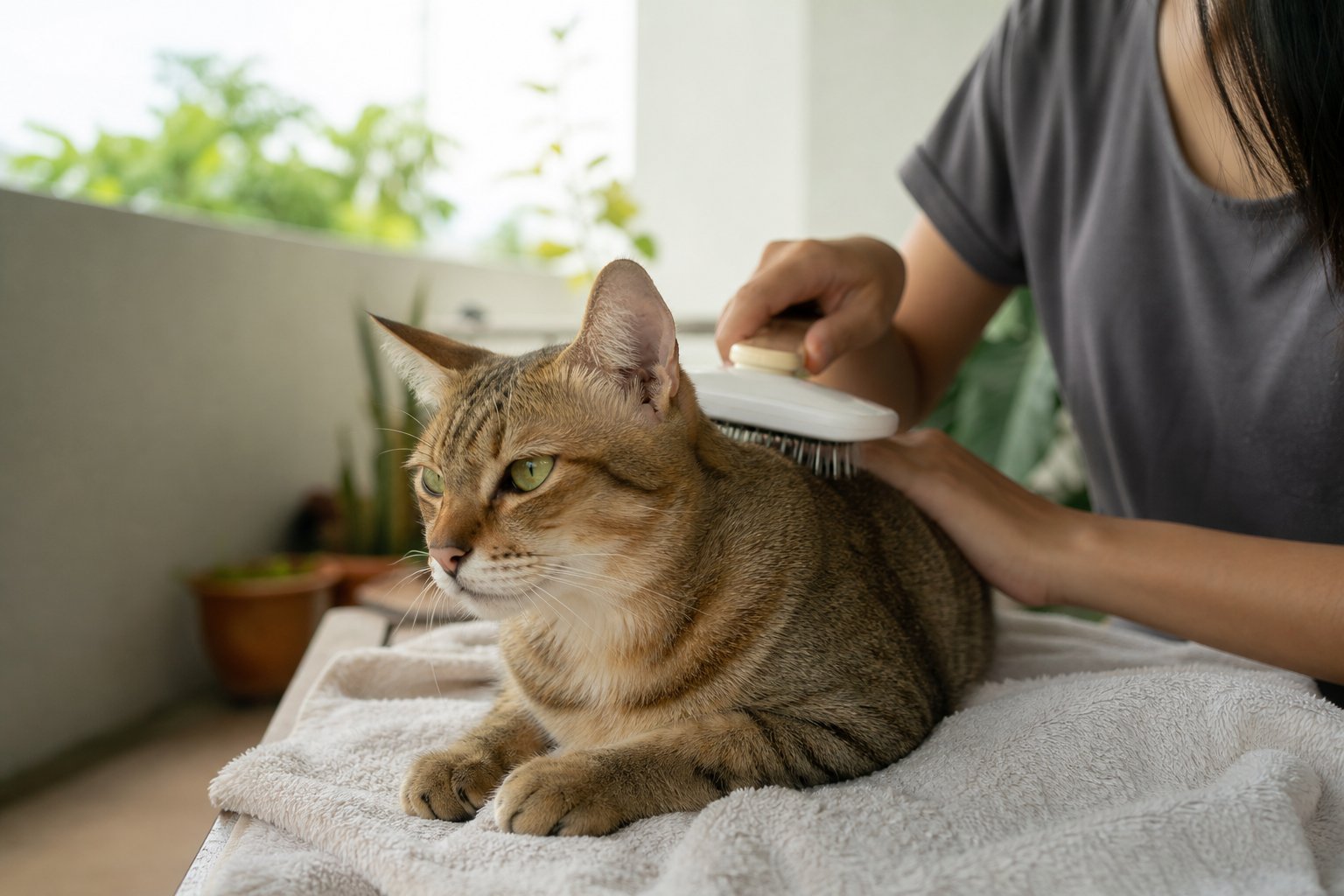
Scent is the invisible currency of cat politics. Cats identify family by a shared scent profile. When you bring a new cat home, everything smells wrong to the resident cat. You can speed up acceptance by swapping bedding, brushing both cats with separate brushes and then swapping, and rubbing a cloth around each cat's cheeks and placing it near the other's resting spots.
Avoid washing all bedding at once during introductions. A completely scent-free home removes the familiar markers that make a resident cat feel secure.
Introducing a new cat: slow is fast
Most failed multi-cat homes fail at the introduction. The common mistake is opening the carrier and hoping for the best.
A workable timeline:
- Set up a safe room for the new cat with its own litter tray, food, water, bed and hiding spot. This room is not a prison; it is a decompression zone.
- Days 1–3: no visual contact. Let both cats smell each other under the door. Feed both near the door so the scent predicts food.
- Days 4–7: crack the door or use a baby gate or stacked pet gates for short, supervised viewing sessions. Reward calm behaviour with treats and end sessions before tension rises.
- Week 2 onwards: supervised time together in a neutral room. Keep sessions short. Separate immediately if there is staring, blocking, hissing that escalates, or a cat is cornered.
- Gradual freedom: allow short unsupervised periods only when both cats are relaxed, then extend.
Expect setbacks. A hiss is communication, not failure. What matters is whether cats can retreat and recover. If one cat hides constantly, stops eating or starts spraying, slow down and add resources.
Reading stress in a multi-cat home
Cats hide stress well. Look for patterns rather than one-off moments.
Warning signs:
- Hiding more than usual, especially at feeding time.
- One cat always waiting until the other leaves a room.
- Spraying on vertical surfaces, doors or laundry.
- Over-grooming, bald patches or scabs.
- Urinating outside the tray, especially on soft items.
- Resource guarding: hovering over food, blocking doorways, staring.
- Reduced appetite, weight loss or vomiting.
- Sudden aggression between cats that previously got along.
Some of these are medical, not behavioural. Cystitis, kidney disease, dental pain, arthritis and hyperthyroidism can all change behaviour. A cat that suddenly avoids the litter tray may be in pain, not spiteful.
When to see a vet
Book a veterinary appointment if you notice:
- Straining to urinate, crying in the litter tray, or frequent tiny urinations, especially in male cats. This can be a urethral obstruction, which is a life-threatening emergency. Go immediately, not tomorrow.
- Blood in urine or repeated accidents outside the tray.
- Sudden appetite loss lasting more than 24 hours.
- Vomiting or diarrhoea that persists or is accompanied by lethargy.
- Weight loss despite normal eating.
- New aggression or hiding that cannot be explained by a recent change, especially in an older cat.
- Over-grooming with skin damage or open sores.
- Any cat that is breathing with effort, open-mouth breathing, or collapses.
Also see a vet before adding a new cat if any resident cat has a chronic illness, is elderly, or is already showing stress. And keep vaccinations, parasite control and desexing up to date; multi-cat homes amplify infectious disease.
Health and hygiene in a multi-cat home
More cats means more exposure. Practical steps:
- Desex all cats unless you are a registered breeder. Desexing reduces spraying, fighting and roaming, and prevents unwanted litters.
- Keep vaccinations current and discuss feline leukaemia virus (FeLV) risk with your vet if cats go outdoors or come from unknown backgrounds.
- Quarantine new arrivals for at least two weeks, with vet checks before mixing.
- Wash bowls daily and litter trays weekly with pet-safe cleaners. Avoid strong disinfectants that cats may lick.
- Groom regularly and check for fleas, ticks and skin issues, particularly in humid weather.
- Weigh cats monthly if possible. A cheap kitchen scale and a towel work fine.
In Malaysia, parasite control matters year-round. Discuss a schedule with your vet rather than copying a friend's routine, because products differ by weight and age.
Daily routine that keeps the peace
A predictable routine lowers anxiety. Cats are crepuscular, most active around dawn and dusk, so schedule play and feeding then.
A sample day:
- Morning: scoop trays, refresh water, separate breakfast, five minutes of individual play with each cat.
- Midday: check that no cat is shut in a room; provide a puzzle feeder or scatter feed for enrichment.
- Evening: separate dinner, interactive play with a wand toy, then a small treat to end the hunt sequence.
- Night: scoop trays again, secure balconies and windows, ensure fresh water.
Individual play matters. Group play often lets the boldest cat monopolise the toy while the shy cat watches. Ten minutes of one-to-one play per cat per day builds confidence and reduces bullying.
Common myths and what actually works
- "They will sort it out." Sometimes, but intervention prevents injury and chronic stress.
- "Punish the aggressor." Punishment increases fear and makes aggression worse. Separate and manage resources instead.
- "One big bowl is fine." It hides illness and causes guarding.
- "Cats are low maintenance." A multi-cat home is more work, not less.
- "A new kitten will cheer up my old cat." A kitten's energy can overwhelm an older cat. Match energy levels and introduce slowly.
A quick checklist before you add another cat
- Can you afford routine and emergency vet care for one more cat?
- Do you have space for an extra litter tray in a separate location?
- Can you feed cats separately every day?
- Is there a room for a two-week introduction period?
- Are all resident cats healthy, desexed and vaccinated?
- Can you commit to daily individual play?
- Do you have a plan if the cats never become friends?
If you answered no to several, wait. Adding a cat should improve life for everyone, including the cats already in your home.
Bottom line
A peaceful multi-cat household is built on separate resources, vertical space, slow introductions and daily observation. Malaysian homes, whether high-rise or landed, can support several cats comfortably when owners plan for scent, humidity, hygiene and escape routes. Watch behaviour closely, treat sudden changes as possible illness, and work with your vet rather than guessing.
This article is general information, not veterinary advice. Always consult a licensed veterinarian in Malaysia about your cat's health, behaviour or treatment plan.
Related reading
- Daily Care Guide Malaysia: A Practical Routine for Dogs and Cats
- Cat Odour Control for Cats: A Step-by-Step Guide for Malaysian Homes
- Cat Tree for Indoor Cats: The Complete Malaysia Guide
- Catnip for Indoor Cats: A Complete Malaysian Guide
- How to Exercise a Cat: A Practical Daily Play Plan for Malaysian Homes
- How to Use a Scratching Post for Cats: A Complete Malaysian Guide
- Interactive Toys for Indoor Cats: A Practical Malaysian Guide
- Moving House with a Cat in Malaysia: A Practical Guide for Cat Owners
- Pet Daily Care Guide Malaysia: Brushing, Nails, Ears, Eyes, Teeth and Weight (2026)
- Scratching Post for Indoor Cats: A Complete Malaysian Guide



