
Quick answer
A cat that coughs now and then is often clearing a hairball or reacting to mild irritation. A cat that coughs repeatedly, wheezes, breathes with its mouth open, or coughs alongside lethargy, appetite loss or nasal discharge needs a vet. In Malaysia, common causes include asthma, cat flu, heartworm and hairballs. Never give a cat human cough medicine.
What a cat cough actually looks like
Many owners mistake a cough for a sneeze, a gag or a hairball. Cats are small and their coughs can be quiet, so it helps to know the shapes.
- Cough: a short, sharp burst of air, often with the neck stretched forward and the body low. It may sound dry and hacking or wet and rattly.
- Sneeze: an explosive burst through the nose, usually followed by nose licking or a bit of discharge.
- Hairball heave: a longer, whole-body retch that often ends with a tubular clump of fur, or nothing at all.
- Reverse sneeze: a snorting, inward gasp, more common in dogs but occasionally seen in cats.
- Open-mouth breathing: not a cough. In cats this is usually serious and needs urgent attention.
A useful trick is to film the episode on your phone. A 20-second video of the actual event is far more useful to a vet than a description, especially if your cat stops coughing the moment it enters the clinic.
The main causes of coughing in cats
1. Hairballs
Hairballs are common in long-haired cats and in cats that groom a lot. The cat swallows loose fur, it clumps in the stomach, and the cat brings it up. True hairballs are vomited, not coughed up, but owners often describe the noise as coughing.
Frequent hairball episodes are not normal. If your cat brings up hairballs more than occasionally, ask your vet about grooming, diet and whether something else is going on.
2. Feline asthma
Asthma is one of the most common causes of chronic coughing in cats. The airways narrow and become inflamed, and the cat coughs, wheezes or breathes with effort. Some cats crouch with their necks extended, looking like they are trying to hack something up.
Triggers include dust, cigarette smoke, mosquito coil smoke, strong cleaning products, aerosol sprays, perfume and cat litter dust. In Malaysia's humid climate, mould and dust mites in soft furnishings can also play a role.
Asthma cannot be cured, but it can usually be managed with vet-prescribed medication, often delivered by inhaler with a spacer made for cats.
3. Cat flu and other respiratory infections
Feline herpesvirus and feline calicivirus cause what owners call cat flu. Signs include sneezing, nasal discharge, eye discharge, fever, mouth ulcers and sometimes coughing. Kittens, unvaccinated cats and cats in multi-cat households are most at risk.
Most cat flu cases are manageable, but some cats become carriers and have flare-ups during stress or illness. Vaccination reduces the severity of disease even when it does not fully prevent infection.
4. Heartworm disease
Heartworm is spread by mosquitoes, which are present year-round in Malaysia. Cats are not the natural host, so the worm burden is usually small, but even a few worms can cause serious lung damage. Signs include coughing, lethargy, weight loss and sometimes sudden collapse.
There is no safe treatment to kill adult heartworms in cats, so prevention is the main strategy. Ask your vet whether your cat's lifestyle and location justify a preventive product.
5. Foreign bodies
A blade of grass, a seed, a piece of string or a small bone can lodge in the throat or airway. The cat may cough suddenly, paw at its mouth, drool or retch. This is often an emergency because the object can move or cause infection.
6. Pneumonia and other lung disease
Bacterial pneumonia, fluid in the lungs and some fungal infections can cause coughing, fast breathing and lethargy. These are serious and need prompt veterinary care.
7. Parasites
Lungworm and other parasites can cause coughing, especially in cats that hunt or spend time outdoors. Regular parasite control, chosen with your vet, reduces the risk.
8. Tumours and age-related changes
Older cats can develop tumours or chronic airway changes. Any new cough in a senior cat deserves a check-up rather than a wait-and-see approach.
Cough type at a glance
| What you notice | Common causes | Urgency |
|---|---|---|
| Occasional dry hack, cat otherwise well | Hairball, mild irritation, dust | Monitor for a few days |
| Repeated dry cough with wheezing | Asthma, chronic bronchitis | Book a vet visit soon |
| Cough with sneezing and eye discharge | Cat flu, respiratory infection | See a vet within a day or two |
| Sudden coughing fit while eating or playing | Foreign body, choking | Emergency |
| Cough with fast or laboured breathing | Pneumonia, asthma attack, heart disease | Emergency |
| Cough with weight loss in an older cat | Tumour, chronic disease, heartworm | Vet visit soon |
| Cough with pale or blue gums | Oxygen problem, shock | Emergency |
How vets work out the cause
There is no single test for coughing. A vet will usually start with a detailed history: how long the cough has been going on, what it sounds like, when it happens, whether the cat goes outdoors, vaccination status and parasite prevention.
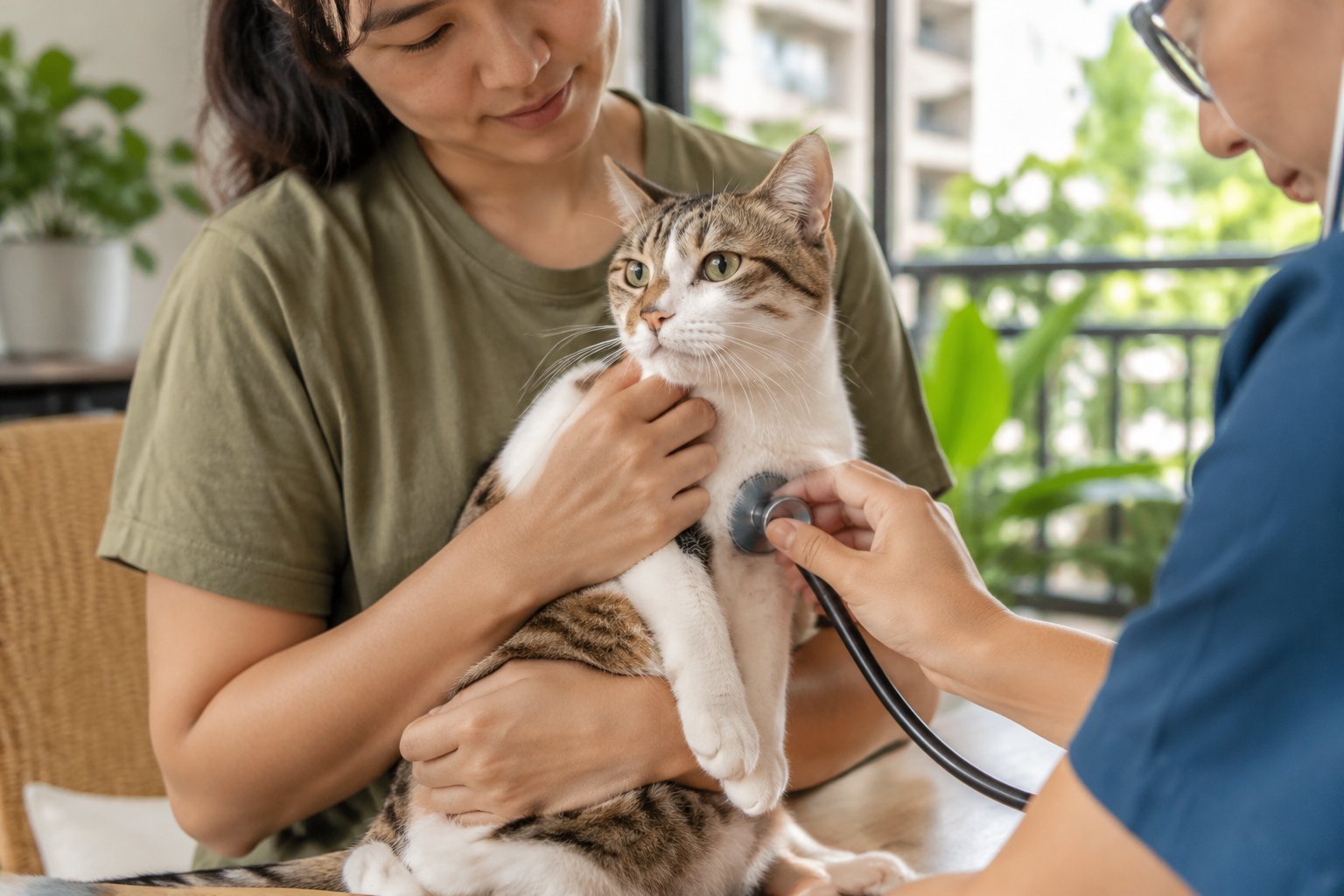
Then comes a physical exam, including listening to the chest with a stethoscope and checking the mouth and throat. Depending on findings, the vet may recommend:
- Blood tests, including a heartworm test where appropriate
- Chest X-rays
- Airway sampling or a bronchoscopy in selected cases
- Faecal tests for parasites
- A trial of treatment to see how the cat responds
Bring your phone video, a list of medications and any questions. Good history-taking often saves time and money.
What you can do at home
Home care supports veterinary treatment; it does not replace it.
- Reduce irritants. Stop smoking indoors, avoid mosquito coils and strong aerosols, switch to low-dust litter, and vacuum soft furnishings regularly.
- Control humidity and mould. Malaysia's wet season can push indoor humidity up. Use ventilation or a dehumidifier where practical, and clean damp areas.
- Groom regularly. Brush long-haired cats to reduce swallowed fur. Ask your vet about hairball diets if needed.
- Keep the cat calm during a coughing fit. Do not hold the cat upside down or put your fingers in its mouth. Let the episode pass, then note how long it lasted.
- Track the pattern. Note time of day, triggers, duration and what the cat was doing. A simple notebook or phone note is enough.
- Keep parasite prevention up to date. Use products recommended by your vet for your cat's age and lifestyle.
- Do not self-medicate. Human cough syrups, decongestants and many herbal remedies are unsafe for cats.
When to see a vet
Contact a vet promptly if your cat:
- Coughs most days or the cough is getting worse
- Wheezes or makes a whistling sound when breathing
- Has nasal or eye discharge, sneezing or a fever
- Is eating less, losing weight or sleeping more than usual
- Has a cough that started after a possible foreign body
- Is an older cat with a new cough
Go to a clinic immediately, or call ahead for emergency advice, if your cat:
- Breathes with its mouth open or its sides heaving
- Has blue, grey or pale gums
- Collapses or cannot settle
- Coughs up blood
- Is straining to breathe after a coughing fit
If you are unsure, call the clinic and describe what you see. Staff can tell you whether to come in now or monitor at home.
Living with a coughing cat in Malaysia
Malaysian homes vary a lot. A Kuala Lumpur apartment with air-conditioning and closed windows may have different dust and mould patterns from a Johor terrace house that opens up to the garden. Cats in high-rise units can still be exposed to mosquito-borne heartworm, and cats in landed homes may meet grass seeds, garden chemicals and free-roaming cats.
During the rainy season, damp bedding and soft furnishings can harbour dust mites and mould. Wash cat beds regularly, dry them fully, and check hidden corners. If your cat's cough worsens when the windows are closed and the air-conditioner is on, mention that pattern to your vet.
Multi-cat households need extra care with cat flu. Keep new cats separated until a vet has checked them, and keep vaccination schedules current.
Prevention checklist
- Keep vaccinations up to date
- Use vet-recommended parasite prevention
- Brush your cat regularly, especially long-haired breeds
- Keep the home smoke-free
- Choose low-dust litter
- Wash bedding often and dry it fully
- Avoid strong aerosols and harsh cleaners near the cat
- Book a check-up if a cough lasts more than a few days
- Film coughing episodes for your vet
The bottom line
Coughing in cats is a sign, not a diagnosis. Most causes are manageable once identified, but asthma, cat flu, heartworm and foreign bodies can become serious if ignored. Watch the pattern, reduce irritants at home, and let a vet examine any cat that coughs repeatedly or looks unwell.
This article is general information for Malaysian cat owners and is not a substitute for veterinary advice. Always consult a licensed veterinarian about your cat's health.
Related reading
- Cat Coughing Treatment in Malaysia: Causes, Home Care & When to See a Vet
- Cat Sneezing Treatment in Malaysia: What to Do and When to Worry
- Constricted Pupils in Cats Malaysia: Causes, When to Worry & What to Do
- Coughing in Cats: Causes and Care (Malaysia Guide)
- Fever in Cats in Malaysia: Signs, Causes and What to Do
- Signs of Fever in Cats in Malaysia: How to Tell and What to Do
- Vomiting in Cats: Causes and Care (Malaysia Guide)
- Vomiting Prevention for Cats: A Practical Guide for Malaysian Owners
- Cat Constipation in Malaysia: The 48-Hour Rule, Red Flags and What Actually Helps
- Cat Constipation Treatment in Malaysia: A Practical Owner's Guide
- Cat Constricted Pupils Treatment in Malaysia: What to Do When Your Cat's Eyes Look Pinpoint