
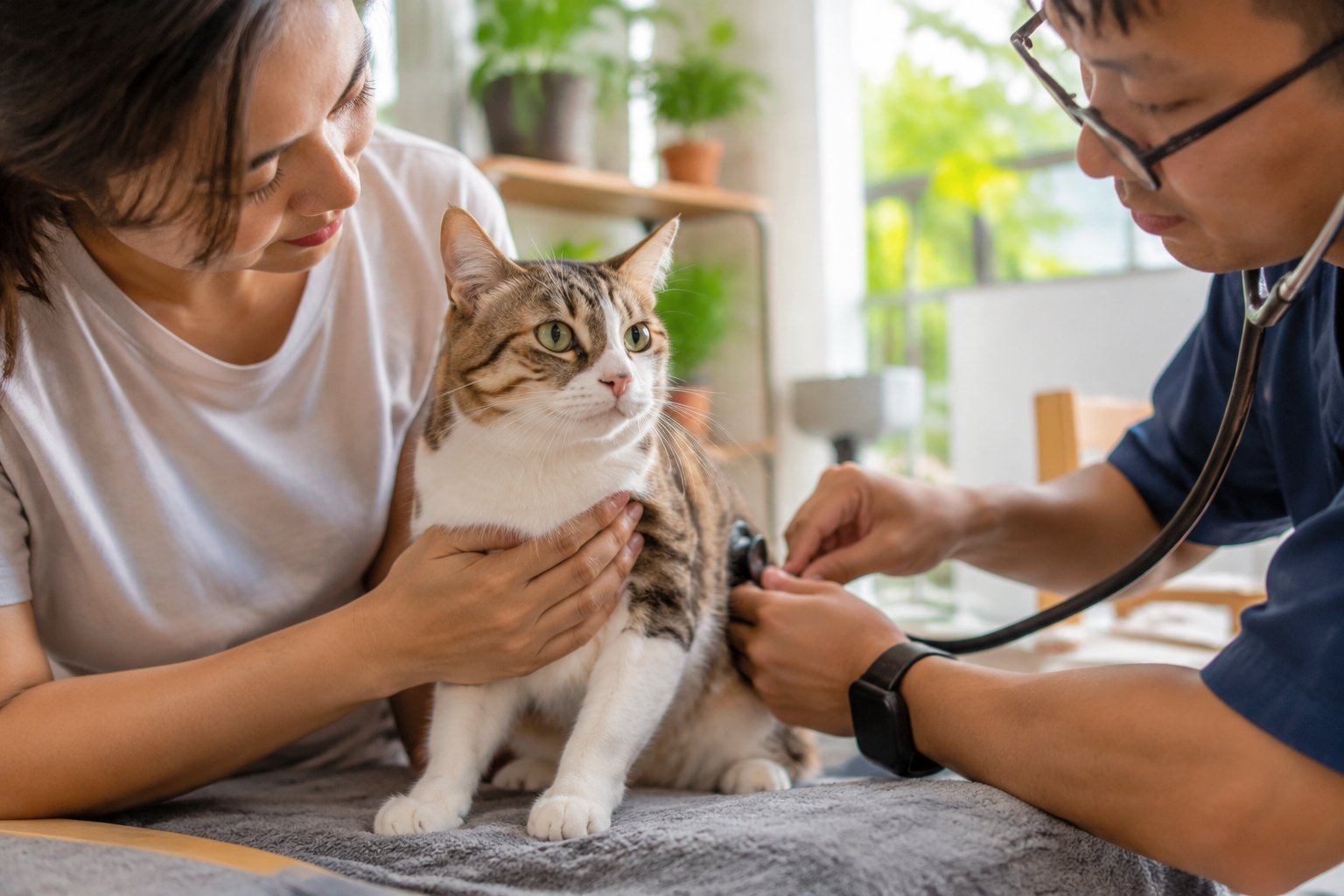
Start with a vet check, not a diet
If your cat looks round, the first move is not to halve the food bowl. Obesity in cats is a medical condition, and several diseases cause weight gain or make weight loss dangerous. Before you change anything, book a check-up so your vet can weigh your cat, score its body condition, and rule out problems such as an underactive thyroid or other metabolic issues.
Your vet can also set a realistic target weight. That number matters because every portion you feed afterwards should be based on it, not on your cat's current weight. Without a target, home dieting becomes guesswork, and guesswork is how cats end up either not losing weight or losing it too fast.
This guide covers the practical, day-to-day side of treating obesity at home: measuring food, choosing a diet, building activity into a Malaysian home, tracking progress, and knowing when to stop and call the clinic.
Why cat obesity is worth treating properly
Carrying extra weight raises the risk of several problems in cats. It puts strain on joints, makes grooming harder (especially for long-haired cats), increases anaesthetic risk during surgery, and is linked with conditions such as diabetes and skin fold infections. Overweight cats also struggle to reach their back for cleaning, which can lead to matting and skin irritation.
The good news is that cats can lose weight safely at home when the plan is structured. The bad news is that cats are notoriously good at demanding food, and owners are notoriously good at giving in. Successful home treatment is less about willpower and more about systems: measured portions, scheduled meals, enrichment that is not food, and regular weighing.
Step 1: Measure everything in grams
Most overfeeding happens because owners use scoops, cups, or "a handful." Scoop sizes vary, kibble density varies, and a slightly heaped scoop can add a large percentage of extra calories over a day.
Buy a cheap digital kitchen scale and weigh your cat's food in grams. Then follow the feeding guide on the pack as a starting point, adjusted to your vet's target weight. If your vet has given you a daily calorie target, weigh out that amount and divide it into meals.
A simple routine:
- Weigh the full day's portion once in the morning.
- Put it in a container and feed from that container only.
- Split it into at least two meals, ideally three or four for a food-motivated cat.
- Never top up the bowl between meals.
If you have multiple cats, feed them separately or use microchip-activated feeders so the overweight cat cannot eat the slim cat's food. This is one of the most common reasons home diets fail.
Step 2: Choose the right diet
There are two broad approaches, and your vet should help you pick.
Reduced portion of a complete adult diet. This works for mildly overweight cats, but the portion can become so small that the cat misses out on essential nutrients. It also leaves the cat hungry and vocal.
A purpose-made weight-management or light diet. These are formulated to be lower in calories but higher in fibre and protein so the cat feels fuller while eating less. They are usually the safer choice for cats that need to lose a meaningful amount of weight.
Wet food. Wet food is lower in calories per gram because of its water content, which can help with volume and hydration. Many owners find a mix of measured wet and dry food easiest to manage.
| Approach | Best for | Watch out for |
|---|---|---|
| Measured regular adult food | Mildly overweight cats, short-term | Portion may get too small; hunger |
| Vet weight-loss diet | Cats needing significant loss | Cost; must be introduced gradually |
| Wet food focus | Cats that eat quickly or beg | Check calorie density on the label |
| Mixed wet + dry | Most households | Easy to double-count calories |
Whatever you choose, transition gradually over seven to ten days to avoid stomach upset. Never put a cat on a very low-calorie diet without veterinary supervision — cats have specific nutritional needs and crash dieting is genuinely dangerous for them.
Step 3: Stop free-feeding and manage treats
Free-feeding a bowl of kibble all day is the single biggest obstacle to weight loss in indoor cats. It makes it impossible to know how much your cat is eating and lets a bored cat graze constantly.
Move to scheduled meals. Two meals a day is the minimum; three or four smaller meals suits cats that beg. If you are out at work all day, a timed feeder can release portions during the day so your cat is not starving by evening.
Treats are where calories hide. A few dental treats, a bit of tuna, and a spoon of wet food "because she asked" can easily add a large share of a cat's daily calories. Set a treat budget — for example, no more than a small fraction of daily calories — and take it out of the main meal, not on top of it. Better still, use a portion of the measured daily food as treats, or use single-ingredient treats in tiny pieces.
Human food is usually a no. Cats do not need table scraps, and many human foods are high in calories, salt, or fat.
Step 4: Make your cat work for food
Enrichment feeding slows eating, adds mental activity, and reduces begging. It is one of the most effective home tools for weight management.
Options include:
- Puzzle feeders and slow feeders for dry food.
- Snuffle mats or scattered kibble on a clean floor.
- Lick mats with a small amount of wet food.
- Food-stuffed toys for part of the daily ration.
- Hiding small portions around the home for your cat to find.
Start easy so your cat does not get frustrated, then increase difficulty. For a food-obsessed cat, replacing one meal a day with a puzzle feeder can make a real difference to both calorie intake and behaviour.
Step 5: Build daily activity into a Malaysian home
Exercise burns calories and, just as importantly, reduces boredom-driven begging. Indoor cats in flats and apartments need deliberate activity because they do not roam.
A realistic routine:
- Two to three short play sessions daily, each 5–10 minutes.
- Use a wand toy and let your cat stalk, pounce, and catch.
- End each session with a successful catch so the hunt feels complete.
- Rotate toys so novelty stays high.
- Use vertical space — shelves, cat trees, window perches — to encourage climbing.
In a Kuala Lumpur apartment, a hallway and a few shelves can be enough for a decent daily circuit. In a Johor terrace house, stairs are a free exercise tool: toss a toy up a few steps or feed part of the ration upstairs. During the Penang rainy season, when outdoor time is limited, indoor play and puzzle feeders become even more important.
If your cat is very overweight, start gently. Short, frequent sessions are better than one long exhausting one, and a cat with joint pain may need a vet check before vigorous play.
Step 6: Weigh and track every two weeks
You cannot manage what you do not measure. Weigh your cat every two weeks on the same scale, ideally a baby scale or a pet scale, and write it down. If your cat will not sit still, weigh yourself holding the cat and subtract your own weight.
Also check body condition by feel. You should be able to feel the ribs under a thin layer of fat, see a waist from above, and feel a tuck at the belly. Photograph your cat from above and from the side every month — changes are easier to see in photos than in the mirror.
A sensible target is roughly 0.5–1% of body weight per week. If your cat is losing much faster, or has stopped losing despite accurate measuring, go back to your vet. Do not simply cut the food further on your own.
Step 7: Manage the household
Weight loss fails for social reasons as often as nutritional ones. Common culprits:
- A family member secretly feeding extra meals.
- Children giving treats.
- Another cat's food left out.
- Neighbours feeding a cat that goes outside.
Agree on one feeding plan for the whole household. Put the plan on the fridge. If your cat goes outdoors, consider keeping it inside or supervised, because you cannot control what it eats elsewhere.
Common mistakes to avoid
- Cutting food drastically overnight. This risks nutritional gaps and, in cats that stop eating, a dangerous liver condition.
- Relying on treats as affection. Use play and grooming instead.
- Weighing food by eye. Use a scale.
- Skipping the vet. Underlying disease must be ruled out first.
- Expecting fast results. Slow loss is safer and more likely to stay off.
- Forgetting the other cats. Separate feeding is essential.
When to see a vet
Contact your vet before starting any weight-loss plan, and seek prompt care if your cat:
- Stops eating for more than 24 hours.
- Vomits repeatedly or has diarrhoea.
- Becomes lethargic, weak, or hides.
- Loses weight very quickly.
- Develops yellowing of the gums or skin.
- Shows signs of pain, limping, or reluctance to move.
A cat that stops eating while on a diet is a genuine emergency risk because of hepatic lipidosis, a serious liver condition. Do not wait it out.
A simple weekly plan you can follow
| Day | Feeding | Activity | Tracking |
|---|---|---|---|
| Monday | Measured meals, one puzzle feeder | 10 min wand play | — |
| Tuesday | Measured meals | 5 min play x2 | — |
| Wednesday | Measured meals, lick mat | 10 min play | — |
| Thursday | Measured meals | Scatter feed one meal | — |
| Friday | Measured meals | 10 min play | — |
| Saturday | Measured meals | Stairs or shelf circuit | Weigh-in |
| Sunday | Measured meals | Gentle play, rest day | Photo update |
The bottom line
Treating obesity in cats at home works when it is structured: a vet-set target weight, food weighed in grams, scheduled meals instead of free-feeding, a controlled treat budget, daily play and puzzle feeding, and a weigh-in every two weeks. Malaysian homes — flats, terraces, rainy-season indoor days — can all support this with a little planning. Go slowly, involve the whole household, and let your vet guide the numbers.
This article is general information only and is not a substitute for veterinary advice. Always consult a licensed veterinarian about your cat's diet, weight target, and health before starting a weight-loss programme.
Related reading
- Cat Health Guide Malaysia: Symptom Check, Red-Flag Triage & When to See a Vet
- Diabetes in Cats: Causes and Care (Malaysian Owner's Guide)
- How to Treat Constipation in Cats at Home: A Practical Malaysian Guide
- Kidney Disease in Cats: Causes, Signs and Care (Malaysia Guide)
- Arthritis in Cats: Causes and Care (Malaysia Guide)
- Bad Breath in Cats: Causes and Care (Malaysian Owner's Guide)
- Blood Test for Cats Step by Step: What Happens at the Clinic
- Breathing Difficulty in Cats in Malaysia: Signs, Causes and What to Do
- Cat Constipation Treatment in Malaysia: A Practical Owner's Guide
- Cat Dehydration Treatment in Malaysia: Signs, Home Care and When to See a Vet
- Cat Diarrhea Treatment in Malaysia: A Practical Owner's Guide
- Cat Fleas Treatment in Malaysia: A Practical Owner's Guide

