
Quick answer
Breathing difficulty in cats is easy to miss until it is severe. The key signs are open-mouth breathing, a resting rate above roughly 40 breaths per minute, laboured or noisy breathing, a neck stretched forward, blue or grey gums, coughing, wheezing and reluctance to lie down. Treat any of these as urgent and contact a vet immediately.
Why cats hide breathing problems
Cats are built to conceal weakness. In the wild, a cat that looks unwell becomes a target, so many cats keep eating, grooming and sitting quietly even when their lungs or heart are struggling. That instinct is why breathing problems often appear suddenly to owners — the cat has been compensating for days or weeks.
Breathing difficulty is not a disease in itself. It is a symptom with many possible causes, from asthma and heart disease to infections, fluid around the lungs, trauma and tumours. Your job as an owner is not to diagnose the cause but to recognise the pattern early and get your cat assessed.
The signs you should watch for
Early or subtle signs
- Breathing faster than usual while resting or asleep.
- Noticeable belly movement with each breath (abdominal effort).
- Sitting in a hunched position with the neck slightly extended.
- Tiring more easily during play or climbing stairs.
- Reduced appetite or hiding more than usual.
- Occasional cough, especially after exercise or at night.
- Noisy breathing or a whistle on inhale.
Clear warning signs
- Open-mouth breathing at rest.
- Panting when the weather is not hot and the cat is not stressed.
- Blue, grey or pale gums and tongue.
- Very fast breathing that does not settle after a few minutes of rest.
- Wheezing or crackling sounds you can hear without a stethoscope.
- Refusing to lie down, or lying with elbows out and neck stretched.
- Collapse, weakness or confusion.
Emergency signs — go now
- Open-mouth breathing with blue gums.
- Gasping or choking.
- Breathing rate that keeps climbing despite rest.
- Sudden collapse or inability to stand.
- A cat that is clearly distressed and cannot settle.
If you see any emergency sign, do not wait for a clinic appointment. Call the nearest veterinary practice, tell them you are coming, and keep your cat calm and cool during transport.
How to check your cat's breathing at home
You do not need equipment to get useful information. A simple count can help your vet decide how urgent the situation is.
- Wait until your cat is asleep or resting quietly for at least five minutes.
- Watch the chest wall rise and fall. Count each rise as one breath.
- Count for 30 seconds and multiply by two.
- Note whether the effort looks normal or laboured, and whether the belly moves strongly.
- Repeat at a similar time on another day to build a baseline.
A healthy resting cat usually breathes around 20 to 30 times per minute. Rates consistently above 40 at rest are a red flag. Breathing that looks effortful matters even if the rate seems acceptable.
| What you observe | What it may mean | Urgency |
|---|---|---|
| Resting rate 20–30, quiet effort | Normal | Routine monitoring |
| Resting rate 30–40, mild belly movement | Possible early problem | Book a vet visit soon |
| Resting rate above 40 | Significant distress | Same-day vet care |
| Open-mouth breathing at rest | Severe distress | Emergency |
| Blue or grey gums | Poor oxygen levels | Emergency |
| Noisy breathing with a stretched neck | Upper airway or lung problem | Urgent assessment |
Common causes of breathing difficulty in cats
Feline asthma. An allergic-type airway disease that causes coughing, wheezing and laboured breathing. It can be triggered by dust, smoke, strong scents and pollen. Many cats respond well to long-term management prescribed by a vet.
Heart disease. Some heart conditions cause fluid to build up in or around the lungs, making breathing fast and difficult. Cats may also tire easily or hide.
Pleural effusion. Fluid in the chest cavity compresses the lungs. Cats often sit with elbows out and breathe shallowly.
Pneumonia and infections. Bacterial or viral infections can cause fever, coughing and rapid breathing.
Upper airway obstruction. Foreign objects, polyps, tumours or severe inflammation can block airflow. Noisy breathing and open-mouth breathing are common.
Trauma. Falls, road accidents and bite wounds can cause lung bruising or collapsed lungs.
Tumours. Growths in the nose, throat or lungs can gradually narrow the airway.
Obesity and heat stress. Overweight cats and hot, humid conditions increase breathing effort. This is not a diagnosis, but it makes underlying problems harder to spot.
What to do while you wait for the vet
- Keep your cat calm. Stress makes breathing worse.
- Move the cat to a quiet, cool, well-ventilated room.
- Do not force food or water.
- Do not give human medicines. Some are toxic to cats.
- If your cat allows it, gently wipe away discharge from the nose without blocking the nostrils.
- Use a carrier with good airflow. Avoid wrapping the cat tightly.
- Call ahead so the clinic can prepare for an emergency.
- If your cat collapses or stops breathing, follow your vet's phone guidance immediately.
What your vet may do
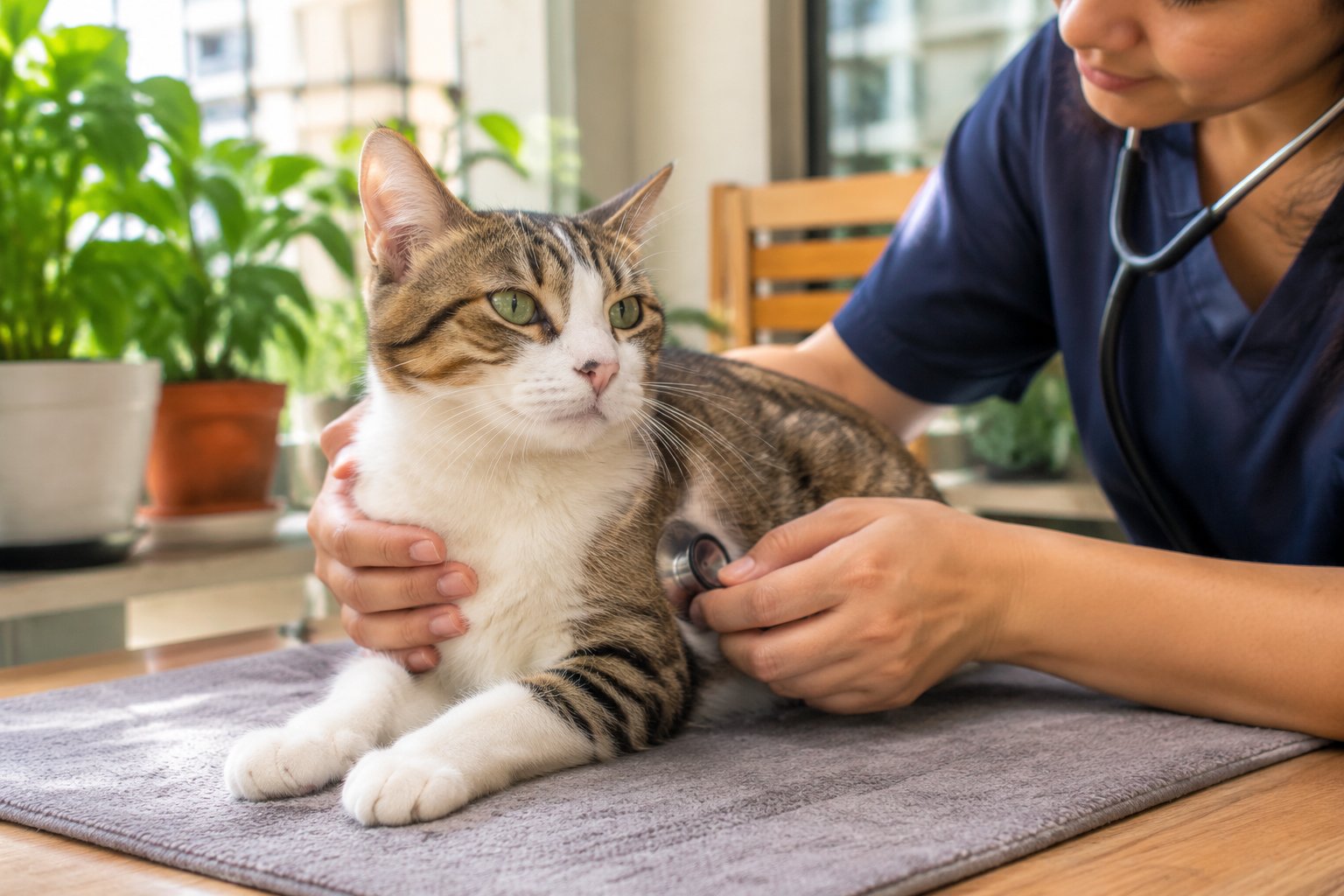
Your vet will start with a calm examination, listening to the chest and checking gum colour, temperature and heart rate. They may ask about the timeline, possible exposures, coughing, appetite and any previous illness.
Depending on findings, they may recommend:
- Chest X-rays to look at the lungs and heart.
- Ultrasound to check for fluid or heart problems.
- Blood tests to assess infection and organ function.
- Airway sampling or swabs in some cases.
- Oxygen support and stabilisation before further tests.
Do not be surprised if your vet prioritises stabilisation over a full diagnosis. A cat in respiratory distress may need oxygen and careful handling before imaging is safe.
Living with a cat that has breathing problems
Long-term management depends on the cause. For asthma, vets often prescribe inhaled or oral medication and advise reducing triggers. For heart disease, regular check-ups and medication are common. For infections, a course of treatment may resolve the problem.
Practical steps at home:
- Keep a simple breathing log with dates and rates.
- Reduce dust, smoke and strong fragrances.
- Use a low-dust litter and avoid spraying air fresheners near the cat.
- Keep the cat at a healthy weight.
- Avoid strenuous play during hot afternoons.
- Keep the carrier out and familiar so travel is less stressful.
- Ask your vet what to do if the breathing rate rises at home.
When to see a vet
See a vet the same day if your cat has a resting breathing rate above 40, a new cough, noisy breathing, reduced appetite with fast breathing, or any change that worries you. Go immediately if there is open-mouth breathing, blue gums, gasping, collapse or severe distress. Do not wait to see if it improves overnight.
Malaysia-specific considerations
Malaysia's hot and humid climate can make breathing problems harder to judge. Cats may pant after exertion or in a warm room, so owners sometimes dismiss panting as normal. Panting at rest, especially indoors with fans or air-conditioning, is not normal and should be checked.
Urban apartments in Kuala Lumpur often have limited airflow, and dust from renovations or nearby construction can trigger coughing in sensitive cats. In Johor terrace houses, cats that go outdoors may be exposed to smoke, vehicle fumes and other animals. During the rainy season in Penang, damp conditions can worsen some respiratory problems and make indoor air quality worse.
Local prices for consultations, X-rays and medication vary between clinics and states. Ask your vet for an estimate before treatment and discuss what is essential first.
Prevention and early detection
You cannot prevent every cause, but you can improve early detection:
- Weigh your cat regularly and keep its body condition healthy.
- Note changes in sleep, appetite and activity.
- Check gums occasionally so you know what normal looks like.
- Avoid smoking indoors and strong cleaning fumes.
- Keep up with routine veterinary check-ups.
- Ask your vet to show you how to count breaths correctly.
A simple home checklist
- Is my cat breathing through its nose with its mouth closed at rest?
- Is the resting rate under 40 breaths per minute?
- Are the gums pink, not blue or grey?
- Is my cat willing to lie down and settle?
- Has coughing or wheezing appeared recently?
- Is my cat eating and drinking normally?
- Is the room cool and free of smoke or strong scent?
If any answer concerns you, call your vet. It is better to be told it is nothing serious than to wait too long.
Final thoughts
Breathing difficulty in cats is a symptom that deserves attention. Learn your cat's normal resting rate, watch for effort and posture changes, and act quickly when warning signs appear. Early recognition gives your vet more options and gives your cat the best chance of a good outcome.
This article is general information only and is not a substitute for veterinary advice. Always consult a licensed veterinarian for diagnosis and treatment of your cat.
Related reading
- Cat Dehydration Treatment in Malaysia: Signs, Home Care and When to See a Vet
- How to Treat Coughing in Cats at Home: A Practical Guide for Malaysian Owners
- How to Treat Dehydration in Cats at Home: A Practical Malaysian Guide
- How to Treat Vomiting in Cats at Home: A Practical Malaysian Guide
- Licking Wounds in Cats Malaysia: When It's Normal and When to Stop It
- Vomiting in Cats in Malaysia: When It's Normal and When to Worry
- Wound Care for Cats: What to Expect, Step by Step

