
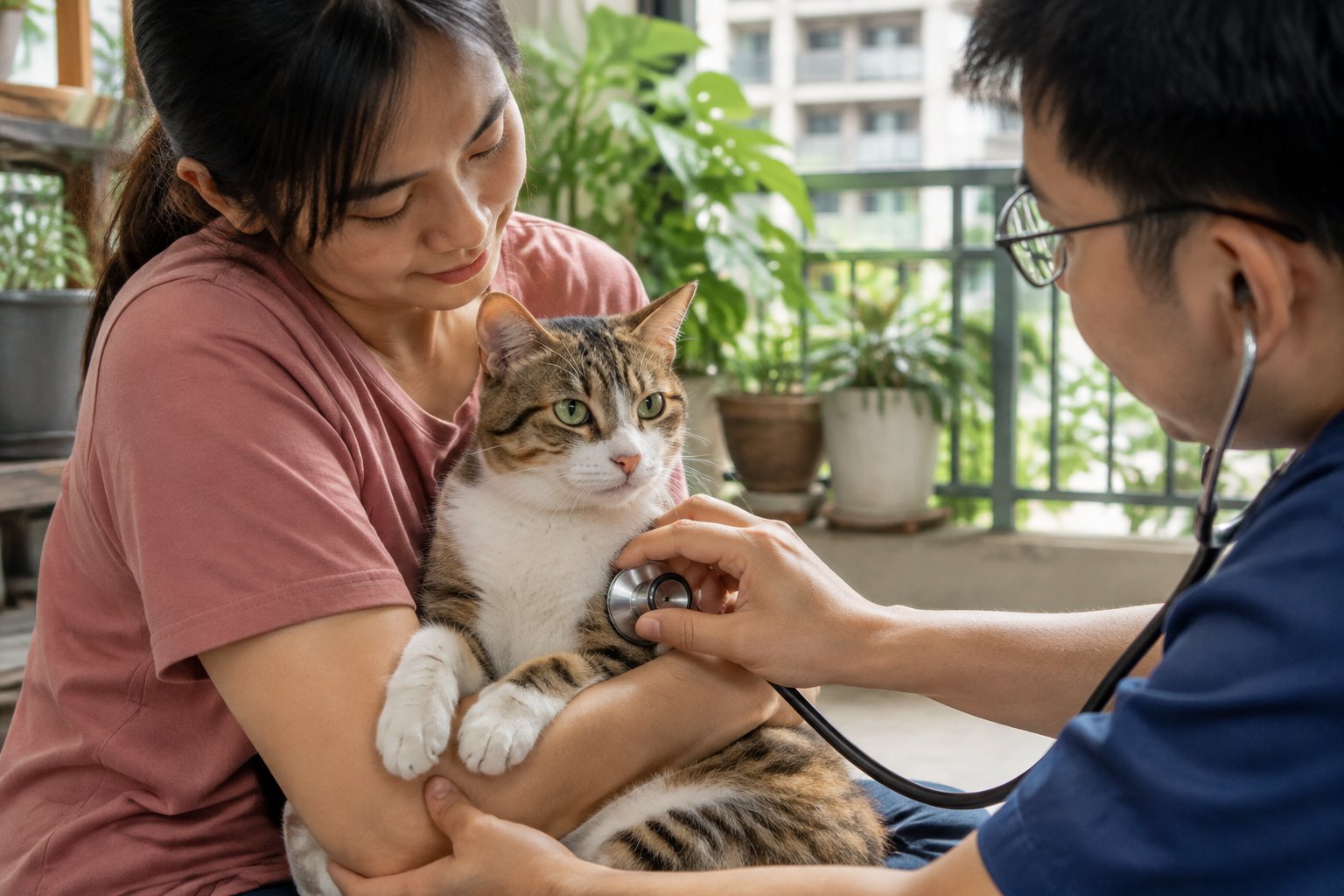
Start with the right question: is your cat actually overweight?
Obesity prevention for cats begins with knowing what a healthy cat looks like. Many owners are surprised when a vet says their cat is overweight, because a chubby cat can look "cute" or "well-fed." In reality, extra body fat raises the risk of diabetes, joint disease, skin problems, breathing difficulty and a shorter lifespan.
The good news: prevention is far easier than weight loss. A lean cat stays lean when feeding is measured, activity is built into the day, and weight is checked regularly. This guide walks through practical steps you can start this week, whether you live in a Kuala Lumpur apartment or a Johor terrace house.
Why prevention beats treatment
Once a cat becomes obese, weight loss requires strict calorie control, frequent weigh-ins and patience. Cats that lose weight too fast can develop hepatic lipidosis, a serious liver condition. That makes prevention the safer, kinder path.
Prevention also protects muscle. Overweight cats carry fat, not healthy muscle, and muscle loss during crash diets is hard to reverse. Keeping your cat at a healthy weight from kittenhood preserves mobility and quality of life into old age.
Indoor cats are at higher risk because they have fewer natural opportunities to move. In Malaysian homes, air-conditioned living and screened windows mean many cats never roam. That makes deliberate exercise and portion control essential.
Step 1: Learn body condition scoring
Body condition scoring (BCS) is a hands-on check of fat cover over the ribs, spine and hips. Most scales run from 1 (emaciated) to 9 (obese), with 4–5 being ideal. You can learn it at home.
How to check at home:
- Stand behind your cat and place both thumbs on the spine, fingers on the ribs.
- Press gently. You should feel ribs easily under a thin layer of fat, like feeling the back of your hand.
- Look from above: there should be a visible waist behind the rib cage.
- Look from the side: the belly should tuck up slightly toward the hind legs.
- Feel the hip bones: they should be palpable but not sharp.
If ribs are hard to feel and there is no waist, your cat is likely overweight. If ribs are invisible and the belly sags, it may be obese. A vet can confirm with a formal BCS at every visit.
| BCS (1–9 scale) | What you feel | What you see | Action |
|---|---|---|---|
| 1–3 | Ribs, spine and hips very prominent | Severe waist, no fat cover | Vet visit; possible underlying disease |
| 4–5 | Ribs easily felt, thin fat cover | Visible waist, slight belly tuck | Ideal; maintain current feeding |
| 6 | Ribs felt with slight pressure | Waist barely visible | Reduce portions slightly; increase play |
| 7 | Ribs hard to feel | No waist, rounded belly | Weight-loss plan with vet |
| 8–9 | Ribs not palpable | Bulging belly, fat pads | Vet-supervised weight loss |
Step 2: Measure food, don't free-feed
Free-feeding is the most common cause of gradual weight gain. A bowl topped up through the day makes it impossible to know how much your cat eats, and multi-cat homes make it worse because one cat may eat more than its share.
Practical feeding rules:
- Use a kitchen scale or measuring cup. Scoops vary; grams are consistent.
- Start with the label's guide for your cat's ideal weight, not its current weight.
- Split the daily ration into at least two meals, ideally three or four.
- Pick up bowls between meals. If your cat grazes, offer smaller, more frequent meals instead of a full bowl.
- In multi-cat homes, feed cats separately or supervise meals so you know who eats what.
- Account for treats and dental chews in the daily total.
If you are unsure of the right amount, ask your vet to calculate a daily calorie target. Local prices for food vary widely, so compare labels and ask a Malaysian retailer or vet for guidance rather than assuming a premium brand is automatically better.
Step 3: Treats under control
Treats are a major hidden calorie source. A few pieces here and there can add up to a significant portion of a cat's daily energy needs, especially for small cats.
Treat rules that work:
- Keep treats to under 10% of daily calories.
- Break treats into tiny pieces; a single treat can be split into four.
- Use a piece of your cat's regular kibble as a treat instead of a separate snack.
- Never feed chips, bread, milk, ice cream or other human foods.
- Use treats for training and reward, not for filling time.
- If you use treats for medication, count them in the daily total.
Step 4: Build activity into every day
Exercise is the other half of the energy balance. Cats are sprinters, not joggers, so short, frequent play sessions work better than one long session.
Daily play plan:
- Two to three sessions of 5–10 minutes each.
- Use a wand toy and mimic prey: move it away from the cat, hide it, let it "escape."
- End each session with a successful catch and a small treat or meal.
- Rotate toys to prevent boredom.
- Try food puzzles and scatter feeding so your cat works for food.
- Provide vertical space: cat trees, shelves and window perches encourage climbing.
- Place food and water in different spots so your cat walks between them.
In a Kuala Lumpur apartment, vertical space is often the easiest way to add activity without floor area. In a Johor terrace house, a secure screened patio or catio can add safe outdoor enrichment.
Step 5: Weigh monthly and track it
Weight creeps up slowly. Monthly weighing catches the trend before it becomes obesity.
How to weigh a cat at home:
- Weigh yourself on a digital scale.
- Pick up your cat and weigh both of you.
- Subtract your weight from the total.
- Record the number and date in a notebook or phone note.
- Weigh at the same time of day, ideally before a meal.
If your cat won't sit still, weigh it in a carrier and subtract the carrier's weight. A vet clinic can also weigh your cat accurately during visits.
What to watch for:
- A steady gain of even 100–200 g per month matters for a small cat.
- Sudden weight loss needs a vet visit.
- Weight gain despite measured feeding may signal a medical issue or hidden calories.
Step 6: Understand food types without falling for myths
Dry food, wet food and raw diets all can support a healthy weight if calories are controlled. The key differences are calorie density, water content and how satisfying the food is.
| Food type | Calorie density | Water content | Practical notes |
|---|---|---|---|
| Dry kibble | High | Low | Easy to measure; watch portions; puzzle feeders work well |
| Wet food | Lower | High | Helps hydration; measure by weight; refrigerate leftovers |
| Mixed feeding | Varies | Medium | Count total calories from both; easy to overfeed |
| Raw | Varies | High | Requires careful hygiene and nutritional balance; discuss with vet |
Grain-free, light and senior formulas are not automatically lower in calories. Always read the label and compare calories per 100 g or per can. If you switch foods, transition gradually over 7–10 days to avoid stomach upset.
Step 7: Remove feeding traps in Malaysian homes
Some habits are common in Malaysian households and quietly promote weight gain.
- Leaving a full bowl out all day. Free-feeding is the biggest trap. Measure and schedule meals.
- Feeding table scraps. Human food is calorie-dense and often high in salt and fat.
- Multiple feeders. Neighbours, family members or children may feed the cat without telling you. Agree on one feeding routine.
- Treats as affection. Replace some treats with play or grooming.
- Assuming a lazy cat is normal. Low activity is often a sign of excess weight or boredom, not personality.
- Ignoring the second cat. In multi-cat homes, one cat may be eating most of the food. Feed separately.
Step 8: Use the vet as a partner
Your vet can body-condition-score your cat, calculate a calorie target, rule out medical causes of weight gain and monitor progress. Book a weight check if you are unsure.
Medical causes to rule out:
- Hypothyroidism (rare in cats but possible)
- Insulin resistance or diabetes
- Fluid retention
- Medication side effects, such as steroids
Never start a weight-loss diet without veterinary guidance, especially for obese cats. Rapid weight loss can trigger hepatic lipidosis.
When to see a vet
See a vet promptly if your cat:
- Is gaining weight despite measured feeding
- Loses weight suddenly or has a changing appetite
- Cannot groom its lower back or reach its tail area
- Shows lameness, reluctance to jump or breathing difficulty
- Has a sagging belly that feels fluid-filled
- Has diabetes symptoms: excessive drinking, urination or hunger
- Is pregnant or has a medical condition affecting weight
A vet visit is also wise before starting any weight-loss plan, especially if your cat is obese or has other health problems.
A simple weekly checklist
- Measure food with a scale or cup
- Count treats and keep them under 10% of calories
- Two to three play sessions daily
- Use a puzzle feeder at least once a day
- Weigh your cat monthly and record it
- Check body condition monthly with hands-on scoring
- Book a vet check if weight is rising
Bottom line
Obesity prevention for cats is built on small, consistent habits: measured meals, controlled treats, daily play, monthly weighing and regular vet checks. Start today, even if your cat is already slightly overweight. Small changes now prevent serious health problems later.
This article is general information only and is not a substitute for veterinary advice. Always consult a licensed veterinarian about your cat's diet, weight and health.
Related reading
- Obesity in Cats: Causes and Care (Malaysian Owner's Guide)
- Obesity in Cats Malaysia: A Practical Guide for Owners
- Anemia in Cats: Causes, Signs and Care (Malaysia Guide)
- Anemia in Cats in Malaysia: Signs, Causes, and What to Do
- Anemia Prevention for Cats: A Practical Guide for Malaysian Owners
- Arthritis in Cats in Malaysia: Signs, Diagnosis and Home Care
- Arthritis Prevention for Cats: A Practical Malaysian Guide
- Bad Breath in Cats in Malaysia: Causes, Home Checks and When to Worry

